Lost, then found: a rediscovered Madagascar palm
Ravenea latisecta was described in 1927 and then went almost a century without a reliable wild record. In 2024, in one of the best-walked forests in Madagascar, a survey team found it again. Here is what a rediscovery actually takes, and why it is the start of the work rather than the end.
- Ravenea latisecta was described in 1927 by Henri Jumelle, from a single specimen collected by Perrier de la Bâthie in eastern Madagascar (Aureglia et al., 2026).
- It then went almost 100 years without a confirmed wild record, meeting the operational definition of a lost species (Long & Rodríguez, 2022).
- In April–May 2024 a team led by Louis Aureglia found 28 individuals at four protected sites in the Andasibe-Mantadia region; the rediscovery was published in Oryx (Aureglia et al., 2026).
- The authors recommend a Critically Endangered assessment: fewer than 50 mature plants, an extent of occurrence of about 50 km² (Aureglia et al., 2026).
- The palm is dioecious, and no fruiting individuals have been seen, so there is not yet any seed for propagation (Aureglia et al., 2026).
- The wider context is stark: 83% of Madagascar's endemic palms are threatened with extinction (Rakotoarinivo et al., 2014).
In 1927 the French botanist Henri Jumelle described a new palm from Madagascar's eastern forests, Ravenea latisecta, working from a single specimen gathered by the great collector Henri Perrier de la Bâthie. Then the species went quiet. For the best part of a hundred years, nobody could point to a living, verified individual anywhere in the wild. The palm existed as a name, a description, and a pressed specimen, and as far as science could say, nothing else.
In 2024 that changed. During fieldwork in April and May, a team led by Louis Aureglia of Aix-Marseille University, working with colleagues including the Malagasy palm specialist Mijoro Rakotoarinivo, found the palm again: 28 individuals across four protected sites in the Andasibe-Mantadia region of central-eastern Madagascar. The rediscovery, published in the conservation journal Oryx in 2026, is a good story on its own. It is a better lesson in how botanical knowledge actually works: what it means for a species to be lost, why even a tree several metres tall can hide for a century, and why finding it again opens a much harder problem than it closes.
Rediscovery figures: Aureglia et al. (2026), Oryx. Palm extinction risk: Rakotoarinivo et al. (2014), the complete Red List assessment of Madagascar's endemic palms.
What "lost" actually means
Lost species sounds like a romantic label. It is in fact an operational one. Under the definition proposed in Oryx by Barney Long and Jon Paul Rodríguez in 2022, a species is lost when it has not been confirmed alive, by photograph, sound recording or genetic evidence, for more than ten years in the wild, and no population survives under human care. A species lost for more than fifty years is long-lost. Crucially, lost does not mean extinct. It means the record has gone silent, and silence is ambiguous: the species may be gone, or it may simply be growing somewhere nobody with the right training has looked.
R. latisecta was an extreme case. Its entire documented existence rested on the material behind Jumelle's 1927 description. That is not unusual for Madagascar. In the IsoGentiX dataset, 537 of the island's endemic plant species are known from a single preserved specimen anywhere on Earth, and 1,656 endemics have a specimen somewhere in the world but none in any Madagascar institution. For species like these, a herbarium sheet is not a supporting document. It is the species' whole scientific existence, and the only anchor a future rediscovery can be checked against.
Lost does not mean extinct. It means the record has gone silent, and silence is ambiguous.
The false trail in the record
There is a twist that makes this story more instructive than most. On paper, the record of R. latisecta did not fall silent in 1927 at all. Herbarium specimens collected in 1992 carried the name, and they had been collected by serious people: Henk Beentje and John Dransfield, whose 1995 monograph The Palms of Madagascar remains the standard account of the island's roughly 170 palm species, more than 95 percent of them endemic. With those sheets in the databases, the species looked documented.
When the 2024 team re-examined the 1992 material, three of the four specimens proved to belong to other Ravenea species, and the fourth could not be confirmed. The palm really had gone unrecorded for close to a century. The database had simply made it look otherwise. That is worth sitting with: an identification in a collection is a claim about identity, made by a human under uncertainty, and claims get revised. Even the best botanists working on a difficult genus, and Ravenea, with about 20 species confined to Madagascar and the Comoros, is a difficult genus, can leave a false trail that takes thirty years to untangle.
Reassignments like this pass straight into any database built on the specimen record, including the IsoGentiX Flora Portal. The right response is not to delete the 1992 collections but to keep them and mark the revision: retained as evidence, identity corrected against the Oryx reassignment. The history of an identification is part of the record, not an embarrassment to be erased. A database that silently overwrote it would be repeating the original mistake in reverse.
Why rediscoveries happen
How does a palm several metres tall stay hidden for a hundred years in one of the most visited forest blocks in Madagascar? Andasibe-Mantadia is not remote by the island's standards. It sits a few hours from Antananarivo, draws researchers and tourists year-round, and is among the best-explored botanical areas in the country. The answer comes in three parts, and each generalises far beyond this one palm.
First, terrain and coverage. Madagascar's eastern forests are steep, wet and vast, and the number of trained field botanists working in them at any moment is tiny relative to the area. Even a well-studied park has slopes and valleys that no botanist has crossed in decades. Second, search image. A palm without flowers or fruit is genuinely hard to name; species in Ravenea are separated by characters of the inflorescence and other technical details, so a sterile tree can be seen, even photographed, without being recognised. Third, misidentification, the false trail described above, which can actively suppress searching: nobody mounts an expedition for a species the database says was collected in 1992.
Rediscovery, when it comes, is rarely one lucky walk in the woods. It is a chain that runs through collections as much as forests: the original specimen that fixes what the name means, the re-examination that exposes the gap, targeted fieldwork in likely habitat, and finally fertile material that can be matched, character by character, against the description written a century earlier. The herbarium is the thread through all of it. Without Perrier's specimen there would be nothing to rediscover against.
Twenty-eight trees, four refuges
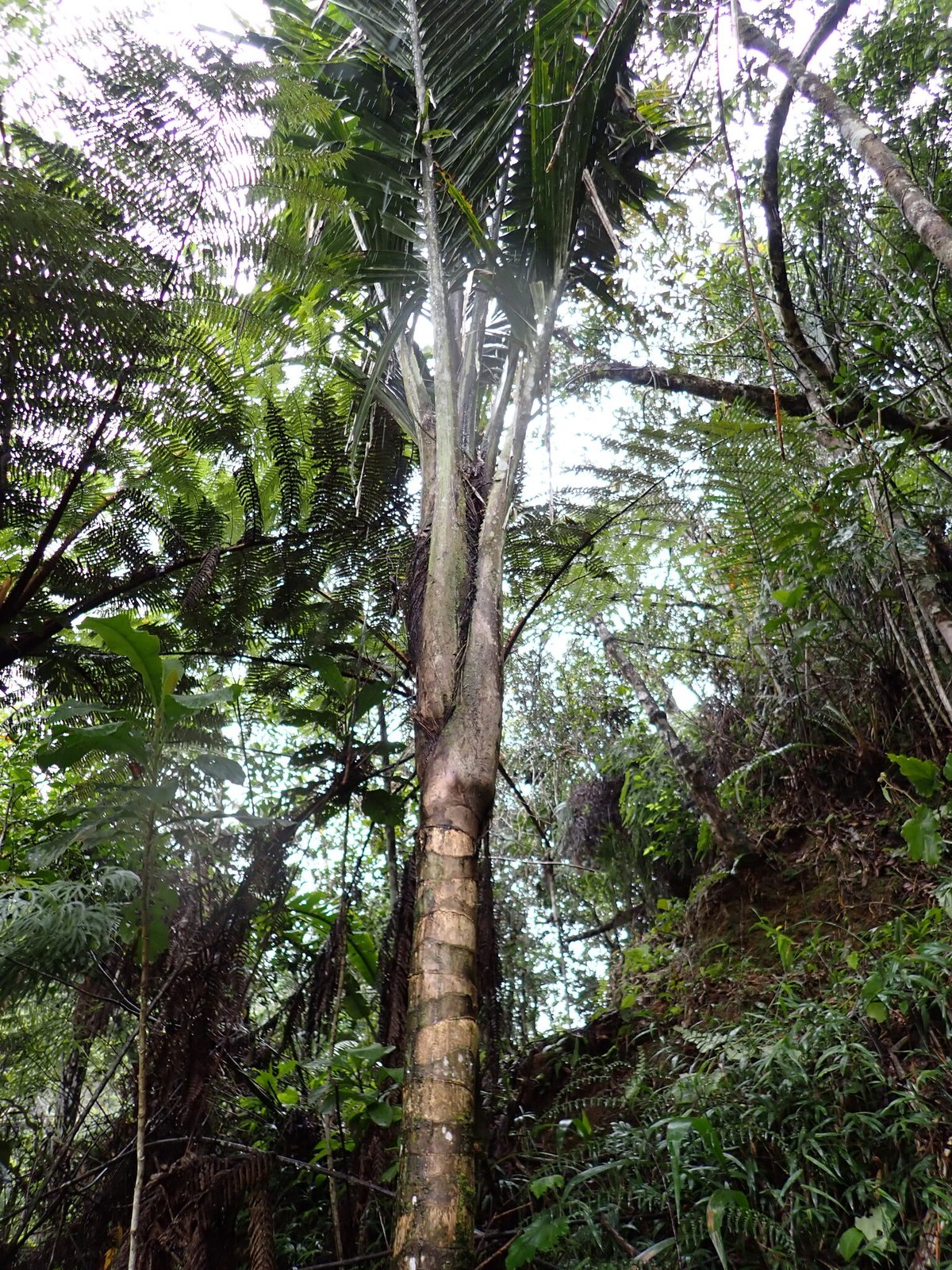
The rediscovered population is small and scattered: 28 individuals across roughly 50 km², in Vohimana Reserve, Analamazoatra, Mantadia National Park and the Vakona Forest private reserve. The good news is in that list. Every known individual stands inside some form of protected area, under management regimes ranging from a national park to a private reserve, which gives the species immediate if uneven shelter from the slash-and-burn clearance eating at the surrounding forest. The team also found no evidence that the palm itself is specifically harvested or used by local communities, which removes one common pressure on Madagascar's palms, several of which are cut for edible palm hearts or construction material.
The precise figures matter because they slot directly into the machinery of assessment. The authors calculated an extent of occurrence of 50.2 km² and an area of occupancy of 28.0 km², and on that basis recommend the species be assessed as Critically Endangered, with fewer than 50 mature individuals known. If future surveys push the count of mature plants above 50, the assessment would shift to Endangered. This is what "what happens after rediscovery" looks like in practice: within months, a plant that officially existed only as a 1927 specimen had coordinates, population figures and a draft Red List category that protected-area managers can act on.
Why one tree is not a population
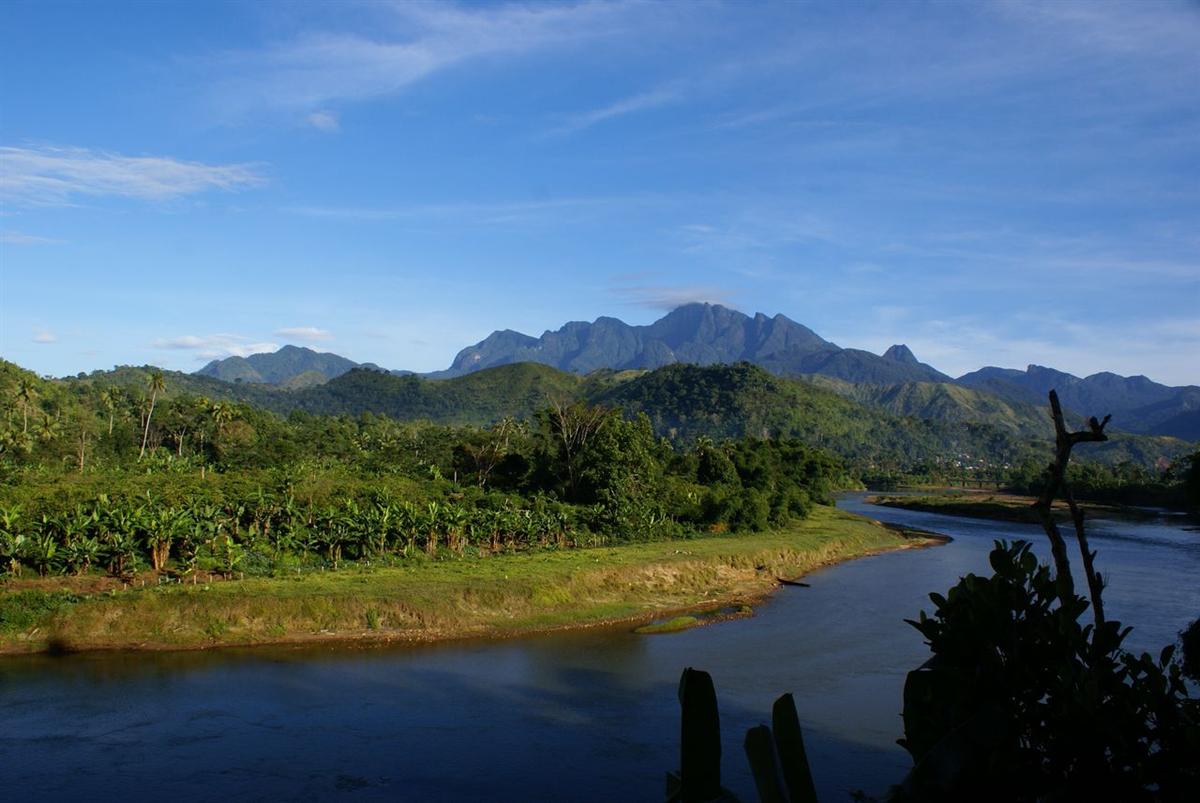
Here the palm's biology sharpens the conservation problem. Ravenea palms are dioecious: an individual tree is either male or female, and only females bear fruit, and only if a male grows close enough for pollen to travel. For a dioecious species, 28 scattered individuals is not simply a small population. It is a population whose effective breeding size is smaller still, because only some fraction are female, only some fraction of those stand within pollination distance of a male, and only mature trees count at all.
This is why a single rediscovered tree, for any dioecious species, is not a recovery. It is a genetic archive with no way to copy itself. And it is why one line in the Oryx paper carries so much weight: no fruiting individuals have yet been observed. Without fruit there is no seed; without seed there is no nursery propagation, no seed-banking, no ex situ insurance population. The species survives, for now, only as the standing trees themselves. The authors' proposed next steps follow directly: work out the flowering phenology and the sex ratio of the known trees, strengthen management of the sites, collect seed for banking and propagation the moment any female fruits, and involve the surrounding communities in protecting the forest the palm depends on.
One palm among hundreds at risk
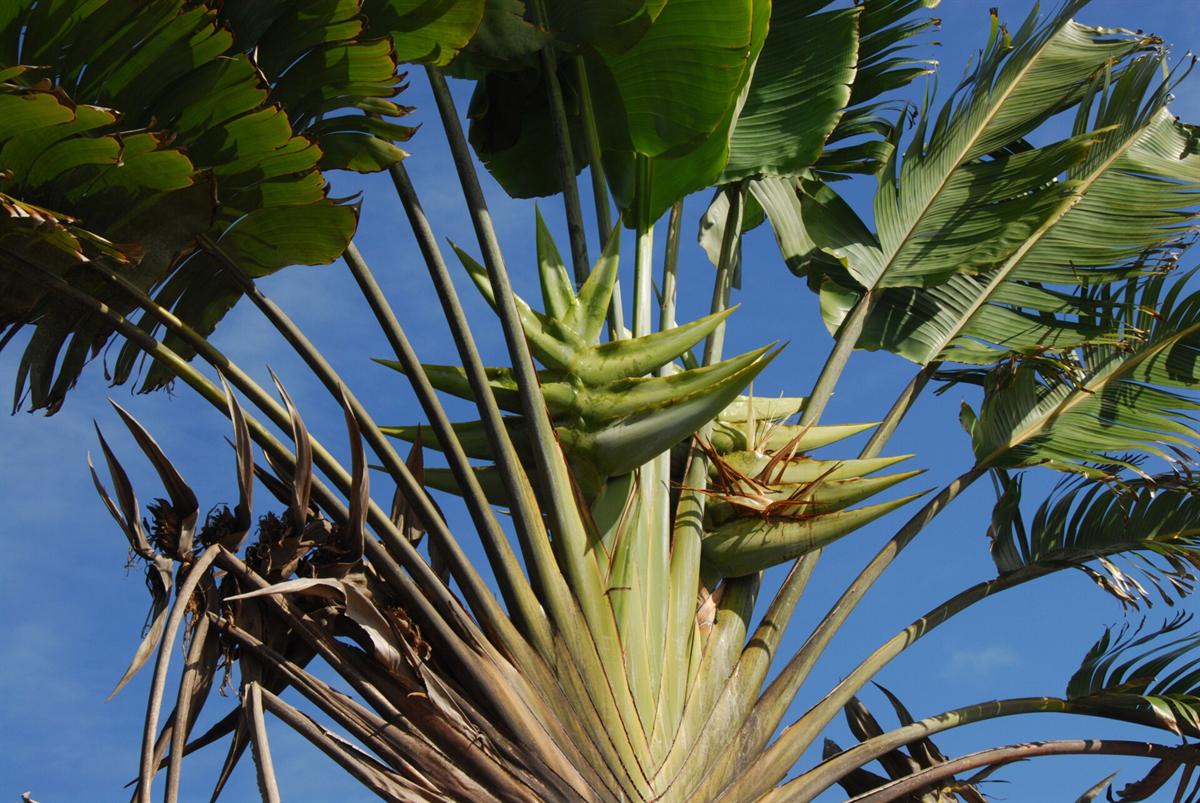
R. latisecta is the headline, but it stands for a much larger problem. Madagascar holds more palm species than the whole of continental Africa, around 170 in the standard monograph and more described since, with over 95 percent found nowhere else (Dransfield & Beentje, 1995). When Rakotoarinivo and colleagues completed the first full Red List assessment of the island's endemic palms, the result was one of the worst figures ever recorded for a large plant group: 83 percent threatened with extinction (Rakotoarinivo et al., 2014). The forests these palms need, the eastern rainforest above all, are shrinking and fragmenting year on year.
The rediscovery therefore leaves a question hanging over the rest of the flora. If a canopy palm could sit unrecorded for a century in Andasibe-Mantadia, hidden partly by terrain and partly by a mislabelled folder, how many other Malagasy species are in the same position: growing quietly in some valley, or sitting misidentified in a collection, one careful re-examination away from being found? The discovery curve for Madagascar's plants is not finished. Neither, ever, is the checking.
Decoding is protecting
This story is the IsoGentiX case made by a single species. Every link in the rediscovery chain was an information problem: a specimen held far from Madagascar, identifications that needed revisiting, records scattered across institutions and databases that disagreed with each other. A flora whose records are digitised, reconciled to a single taxonomic backbone, georeferenced and honest about the history of every identification makes the next R. latisecta findable in years rather than decades, and makes its absence, if it truly is extinct, provable rather than presumed. That is the work of the IsoGentiX Flora Portal, done by consent and returned in digital form under national authority, so that the record of Madagascar's plants is usable in Madagascar. Decode:Protect.
Common questions
What is a lost species?
Under the definition published in Oryx, a lost species is one not confirmed alive by photographic, audio or genetic evidence for more than 10 years in the wild, with no population under human care. Species unrecorded for more than 50 years are long-lost. Ravenea latisecta went almost a century without a reliable wild record (Long & Rodríguez, 2022).
Who rediscovered Ravenea latisecta, and where?
A team led by Louis Aureglia of Aix-Marseille University, working with Malagasy and French colleagues, found the palm during fieldwork in April and May 2024 at four protected sites in the Andasibe-Mantadia region: Vohimana Reserve, Analamazoatra, Mantadia National Park and the Vakona Forest private reserve (Aureglia et al., 2026).
How can a palm several metres tall stay lost for a century?
Because looking is hard and identity is harder. Madagascar's forests are vast and its field botanists few, sterile palms are difficult to name, and specimens collected in 1992 under the name R. latisecta proved on re-examination to be other Ravenea species, so the record looked fuller than it was.
Is the species safe now that it has been found?
No. Only 28 individuals are known and the authors recommend a Critically Endangered assessment, with fewer than 50 mature plants. The palm is dioecious, so it needs male and female trees close together to reproduce, and no fruiting individuals have yet been seen, which blocks seed collection and propagation for now (Aureglia et al., 2026).
Sources and further reading
- Aureglia, L., Hardion, L., Rakotoarinivo, M. & Vila, B. (2026). Rediscovery of Ravenea latisecta Jum. (Arecaceae) after a century, and the conservation implications. Oryx, First View, 1–4. cambridge.org, the rediscovery paper: sites, counts, assessment and proposed actions.
- Mongabay (2026). Rare palm tree rediscovered in Madagascar after nearly 100 years. news.mongabay.com, report with Aureglia's account of the confirmation.
- Long, B. & Rodríguez, J.P. (2022). Lost but not forgotten: a new nomenclature to support a call to rediscover and conserve lost species. Oryx, 56(4), 481–482. cambridge.org, the operational definition of a lost species.
- Rakotoarinivo, M. et al. (2014). Comprehensive Red List assessment reveals exceptionally high extinction risk to Madagascar palms. PLOS ONE, 9(7), e103684. journals.plos.org, 83% of endemic palms threatened.
- Dransfield, J. & Beentje, H.J. (1995). The Palms of Madagascar. Royal Botanic Gardens, Kew & the International Palm Society. The standard monograph: ~170 species, >95% endemism.
- Antonelli, A. et al. (2022). Madagascar's extraordinary biodiversity: evolution, distribution, and use. Science, 378(6623), eabf0869. science.org, the island-wide context for endemism and threat.
- Re:wild. The Search for Lost Species. rewild.org, the global programme tracking lost and rediscovered species.
- Govaerts, R. et al. World Checklist of Vascular Plants (WCVP). Royal Botanic Gardens, Kew. powo.science.kew.org, the taxonomic backbone the IsoGentiX figures reconcile to.