Madagascar's eastern rainforest
A green spine down the island's Indian Ocean edge, fed by the trade winds and stacked into bands of forest from the lowlands to the cloud. It is Madagascar's wettest and most species-rich biome, held together by the lemurs that plant its trees, and it is the front line of the island's deforestation.
- The eastern rainforest is a perhumid biome running roughly 1,500 km along the escarpment, fed by the south-east trade winds forced up off the Indian Ocean; the wettest places take more than 3,000 mm of rain a year.
- It is arranged by elevational zonation: lowland rainforest, montane forest, mossy cloud forest and summit thicket, a full sequence preserved on massifs such as Marojejy.
- The richest plant families are Rubiaceae and orchids (Madagascar has close to 1,000 orchid species, over 90% endemic), with palms (~200 species) and Apocynaceae close behind (Andriananjamanantsoa et al., 2016; Dransfield & Beentje, 1995).
- Many rainforest trees are large-seeded and depend on lemurs to disperse them; the loss of large-bodied frugivores threatens the forest with an "empty forest" future (Federman et al., 2016).
- Madagascar has lost most of its original forest and it is still fragmenting; six decades of national data record continued loss and edge effects (Vieilledent et al., 2018).
Stand at the foot of the eastern escarpment on a warm afternoon and you can watch the biome make itself. Cloud rolls in off the Indian Ocean, piles against the wall of hills, and lets go. The rain that falls here does not fall on the dry west or the spiny south. It falls on a narrow strip of country that runs almost the whole length of the island, and it has been falling on that strip, warm and reliable, for a very long time. That single fact, water in quantity and without a real dry season, is the engine behind Madagascar's wettest and most species-rich biome.
The eastern rainforest is the forest most people picture when they picture Madagascar: tall, dripping, hung with orchids and ferns, alive with lemurs. It is also the forest under the most pressure. Understanding why it is so rich, and why it is so fragile, means starting with the wind.
Island-wide native and endemic figures follow Antonelli et al. (2022) and Callmander et al. (2011). Orchid richness follows the Malagasy orchid literature (Andriananjamanantsoa et al., 2016). Rainfall is a maximum for the wettest escarpment sites, not an island average.
Why the east is wet: the trade winds and the wall
Madagascar sits in the belt of the south-east trade winds. These winds blow steadily off the Indian Ocean, picking up moisture across hundreds of kilometres of warm sea. When they reach the island they meet the eastern escarpment, a long, steep rise from the coastal plain up to the central highlands. The air has nowhere to go but up. As it climbs it cools, and cooling air cannot hold as much water vapour, so the moisture condenses and falls as rain and cloud on the eastern slopes. This is orographic rainfall, the same mechanism that wets the windward side of any coastal mountain range.
The consequence is a sharp asymmetry. The eastern slopes are perhumid: rain in every month, high humidity, no true dry season to speak of. By the time the winds crest the highlands and descend the far side, they have dropped most of their water and warmed again, so the west and south sit in a rain shadow and support the dry forests, the limestone tsingy and the spiny desert instead. One island, one prevailing wind, and two utterly different plant worlds on either side of the divide.
Forests stacked on a mountain: elevational zonation
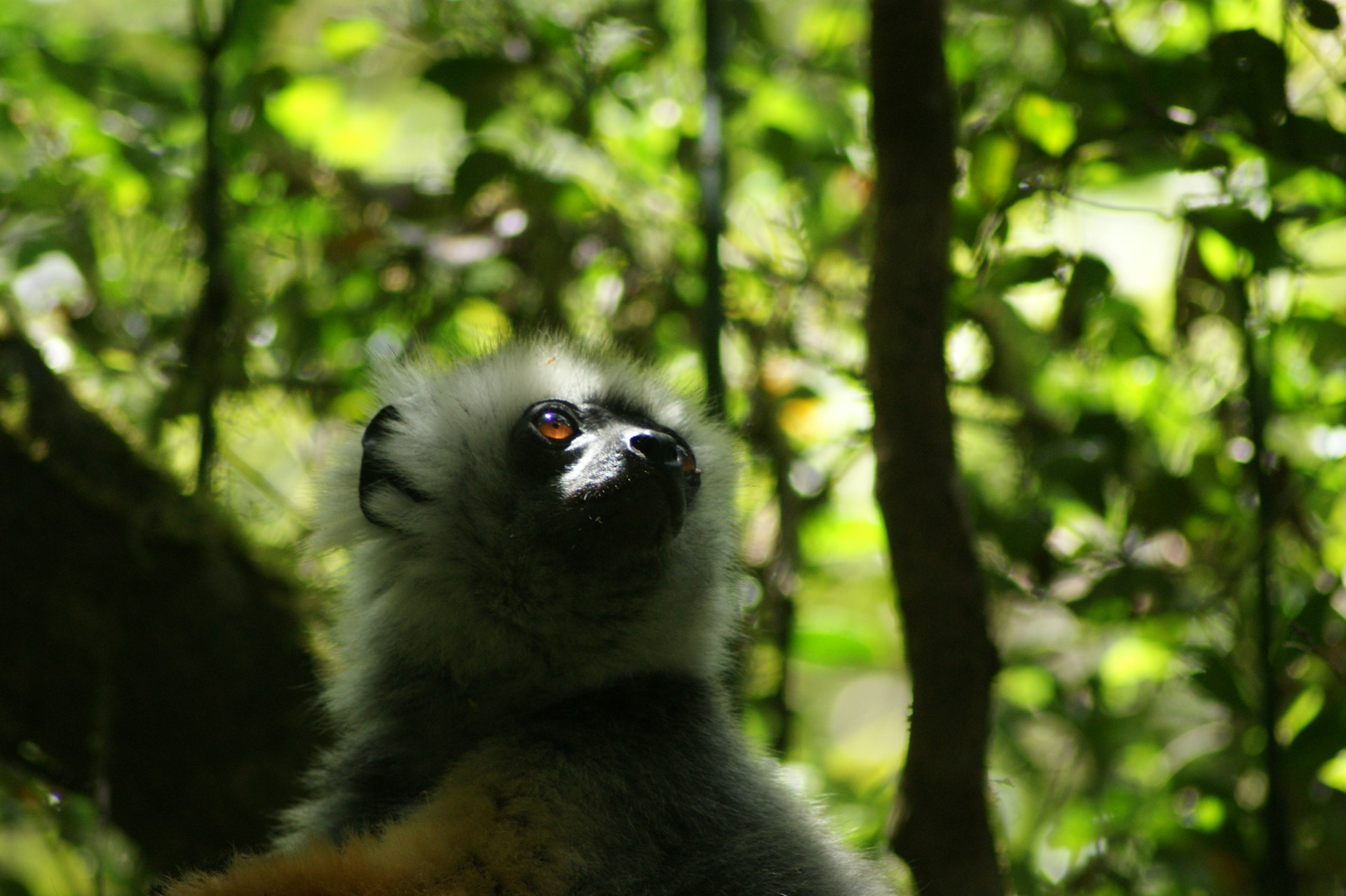
Rain explains why the east is forested. Height explains why one patch of that forest can hold so many kinds of plant. As you climb a tropical mountain, temperature falls by roughly half a degree for every hundred metres of ascent, humidity and cloud increase, and the soils grow thinner and more waterlogged. Plants track these gradients, so the forest changes in recognisable bands as you go up. The technical name for this layering is elevational, or altitudinal, zonation, and Madagascar's eastern massifs show it as clearly as anywhere in the tropics.
Marojejy, a granite massif in the north-east that rises from lowland forest to a bare peak above 2,000 m, is the classic example. Its slopes preserve the whole sequence in one place. Below about 800 m stands tall lowland rainforest, a closed canopy 25 to 35 m high, thick with palms, tree ferns and epiphytes. From roughly 800 to 1,400 m the forest shortens into montane rainforest, canopy 18 to 25 m, with more light reaching a floor crowded with mosses and ferns. Higher again the trees become gnarled and low, wrapped in moss and dripping with cloud: this is the sclerophyllous montane and cloud forest, some of the last of its kind on the island. Near the summit, where the wind is constant and the soil is little more than wet grit, the forest gives out entirely and is replaced by low ericoid thicket, dwarf shrubs and miniature palms among bare rock.
Each band is, in effect, a different habitat with a different set of species, and many plants are confined to a single band. That is why a single tall massif can hold several floras stacked on top of one another, and why protecting a mountain from base to peak protects far more diversity than protecting the same area of flat lowland. It is also why the east, with its long chain of escarpment peaks, packs in so many species: it is not one rainforest but a series of them, laid out vertically as well as along the coast.
Who lives here: the dominant families
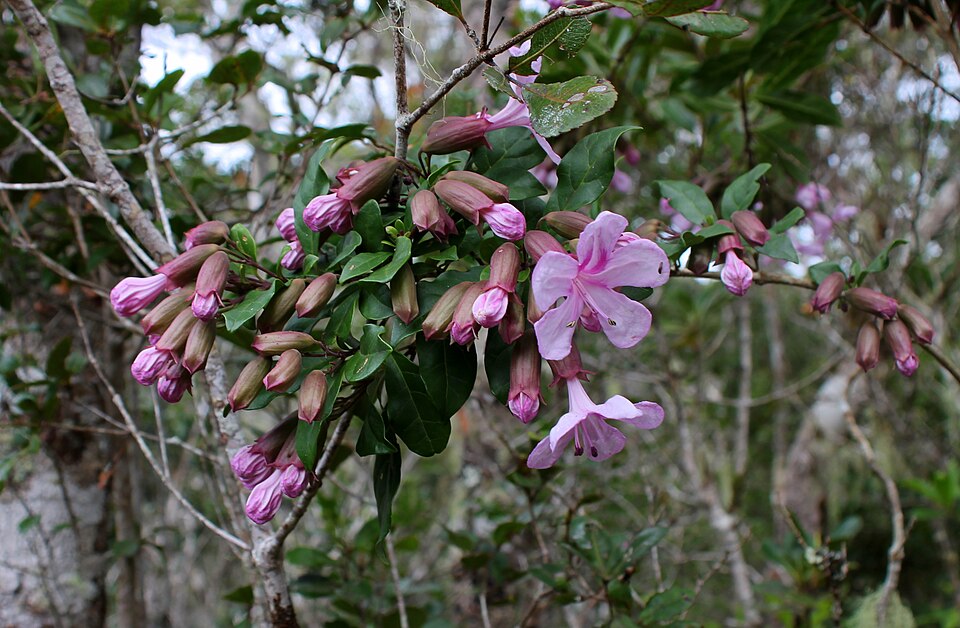
The eastern rainforest is not dominated by a handful of giant trees the way some tropical forests are. Its character comes from a few very large, very diverse plant families spreading into every layer of the forest. The two richest are the Rubiaceae, the coffee family, and the orchids. Rubiaceae fill the understorey and canopy with hundreds of species of shrub and tree, many still poorly known, and the family includes wild coffees, of which Madagascar has a striking number of endemic species. The orchids are the showpiece: Madagascar has close to 1,000 orchid species, more than 90% of them endemic, and the eastern forest is their headquarters. The genus Angraecum alone accounts for about 140 Malagasy species, most of them found nowhere else, and includes Angraecum sesquipedale, the comet orchid whose foot-long nectar spur famously led Darwin to predict the existence of a long-tongued hawkmoth to pollinate it (Andriananjamanantsoa et al., 2016).
Palms are the third signature. Madagascar has around 200 palm species, nearly all endemic and heavily concentrated in the wet east, giving the island more native palm diversity than the whole of continental Africa (Dransfield & Beentje, 1995). Add the Apocynaceae, with their distinctive alkaloid chemistry, the Euphorbiaceae, the Clusiaceae and the Myristicaceae, and you have the framework of the forest. The recurring theme is the same one that runs through all of Madagascar's flora: old, isolated lineages that have diversified in place for tens of millions of years, so that what grows here is related to, but chemically and morphologically distinct from, its relatives on the mainland.
| Family | Malagasy genera of note | Why it matters |
|---|---|---|
| Rubiaceae | Coffea, Ixora, Gaertnera | One of the richest families in the forest; many endemic wild coffees; still under-studied |
| Orchidaceae | Angraecum, Aerangis, Bulbophyllum | ~1,000 species, >90% endemic; epiphytes that define the wet forest interior |
| Arecaceae (palms) | Dypsis, Ravenea, Marojejya | ~200 species, nearly all endemic; more native palms than continental Africa |
| Apocynaceae | Catharanthus, Tabernaemontana, Voacanga | Distinctive alkaloid chemistry; the source of medically important compounds |
The east is not one rainforest but a stack of them, laid out up the mountains and along the coast, each band holding plants that grow in no other.
The forest that plants itself: lemurs and seed dispersal
A rainforest is not only its plants. It is the web of relationships that keeps those plants reproducing, and in Madagascar the most important of those relationships is between fruiting trees and lemurs. On most continents, seed dispersal is shared among monkeys, birds, bats, rodents and large mammals. Madagascar never had those animals. Its dispersers are lemurs, and to a lesser extent a few birds and fruit bats, which means the job of moving seeds around the forest falls on a much narrower cast than it does elsewhere.
The mechanism is straightforward. A lemur eats fleshy fruit, the seed passes through its gut unharmed, and it is deposited somewhere away from the parent tree, often in a patch of light where it has a better chance of growing. For many trees this is not a bonus but a requirement. Their seeds are too large to be moved by wind or by small animals, and without a lemur to swallow and carry them they simply drop and rot beneath the parent, where competition and pests kill most of them. A study of two large-seeded trees in eastern Madagascar found the brown lemur, Eulemur fulvus, was the sole disperser, removing more than half the crop of one species and carrying seeds to the microsites where seedlings could actually establish (Sato, 2022). Take the lemur out of that picture and the tree loses its future, even if every adult is left standing.
This is why the fate of lemurs and the fate of the forest cannot be separated. Twenty-odd lemur species are fruit-eaters and most of them are threatened. Where they are hunted out or cut off in forest fragments too small to feed them, the trees they serve lose their gardeners. Protecting the eastern rainforest is not only about keeping the trees standing. It is about keeping the animals that keep the trees coming back.
The deforestation front
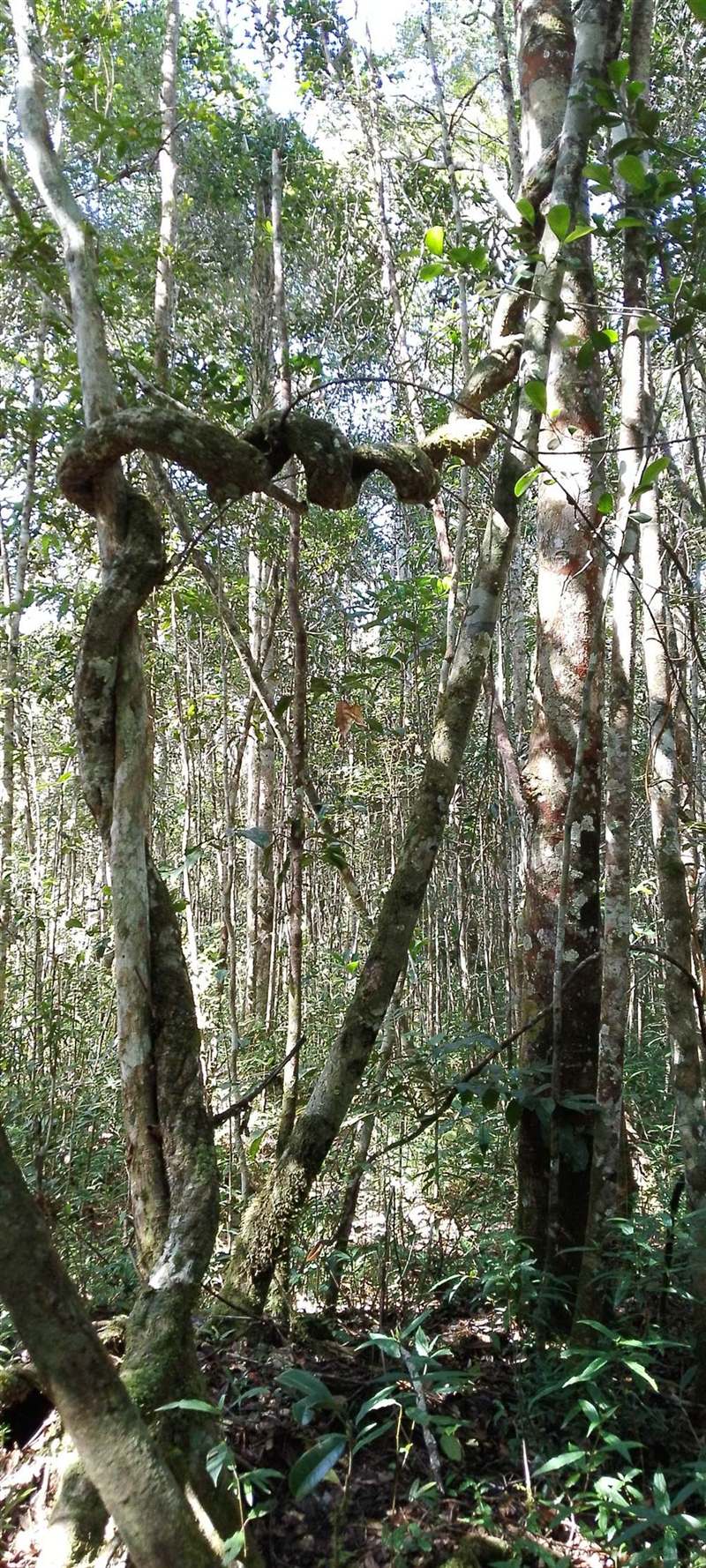
The eastern rainforest is also where Madagascar loses most forest. It is warm, wet and fertile, which makes it attractive for the slash-and-burn cultivation of rice and other crops known locally as tavy, and its trees are cut for timber and burnt for charcoal. The national record assembled by Vieilledent and colleagues, which stitches together six decades of maps and satellite data, shows the forest shrinking and, just as important, fragmenting: broken into ever smaller pieces with ever more edge (Vieilledent et al., 2018). Fragmentation matters because a forest edge is a different place from a forest interior. It is hotter, drier, windier and more easily invaded, so the belt of degraded habitat around each fragment eats inward long after the clearing itself has stopped.
Fragmentation also breaks the seed-dispersal web. Lemurs will not cross wide open ground, so a forest chopped into islands is a forest whose gardeners can no longer move between the pieces. The surviving corridors, the protected blocks around Marojejy, Masoala, Ranomafana, Andringitra and Mananara, matter out of all proportion to their area, because they are large enough to keep both the plants and the animals that sustain them. Everything smaller is running the empty-forest risk in slow motion.
Across Madagascar, 1,656 endemic species have a preserved specimen somewhere in the world but none in any Madagascar institution, and 537 endemics are known from a single specimen anywhere on Earth. Many of these are rainforest plants, collected once from a forest that may since have been cleared. For a species like that, the herbarium sheet abroad, and the digital record of it, can be the only form in which its own country is able to study it.
Custody figures are computed from the IsoGentiX Flora dataset (reconciled to the WCVP backbone) and reflect what has so far been digitised and localised; the site-wide dataset holds 13,685 recorded plant names for Madagascar.
Decoding is protecting
The eastern rainforest is the strongest case for the work IsoGentiX exists to do. It is the richest biome on the island, the least studied relative to its diversity, and the fastest disappearing. A plant recorded, named, georeferenced to the forest block it came from and assessed for extinction risk can be argued for when land use is decided, and can be recognised again if it turns up in a fragment nobody thought to survey. A plant known only as an unlabelled sheet in a distant drawer cannot. Mapping which species lives in which corridor, tying it to the animals that disperse it, and returning that record to Madagascar in a form its own scientists can use is exactly what the IsoGentiX Flora Portal is for. Decode:Protect.
Common questions
Why is Madagascar's eastern rainforest so wet?
The south-east trade winds carry moisture off the Indian Ocean and are forced up the steep eastern escarpment. The air cools as it rises and drops its water on the way up, so the eastern slopes are perhumid, with more than 3,000 mm of rain a year in the wettest places, while the west of the island sits in a rain shadow.
What is elevational zonation?
As you climb a rainforest mountain, temperature falls and the forest changes in bands. At Marojejy the forest runs from tall lowland rainforest below about 800 m, through shorter montane forest, into mossy cloud forest, and finally low ericoid thicket near the summit. Each band holds different plants, so a single mountain stacks several floras on top of one another.
Which plant families dominate the eastern rainforest?
Rubiaceae (the coffee family) and orchids are the two most species-rich, followed by palms, Apocynaceae, Euphorbiaceae and Clusiaceae. Madagascar has close to 1,000 orchid species and around 200 palm species, the great majority of them endemic and concentrated in the wet east.
What is the "empty forest" risk?
Many rainforest trees have large seeds that only large-bodied lemurs can swallow and carry away. If those lemurs are hunted or lost to fragmentation, the trees lose their dispersers. The forest can still look green while its large-seeded trees quietly fail to regenerate, an empty forest whose canopy is not being replaced.
Sources and further reading
- Antonelli, A. et al. (2022). Madagascar's extraordinary biodiversity: evolution, distribution, and use. Science, 378(6623), eabf0869. science.org
- Callmander, M.W. et al. (2011). The endemic and non-endemic vascular flora of Madagascar updated. Plant Ecology and Evolution, 144(2), 121–125. plecevo.eu
- Vieilledent, G. et al. (2018). Combining global tree cover loss data with historical national forest-cover maps to look at six decades of deforestation and forest fragmentation in Madagascar. Biological Conservation, 222, 189–197. sciencedirect.com
- Federman, S. et al. (2016). Implications of lemuriform extinctions for the Malagasy flora. Proceedings of the National Academy of Sciences, 113(18), 5041–5046. pnas.org. The "empty forest" and giant-lemur dispersal argument.
- Sato, H. (2022). Significance of seed dispersal by the largest frugivore for large-diaspore trees. Scientific Reports, 12, 20024. ncbi.nlm.nih.gov. Brown lemur as sole disperser of large-seeded eastern-forest trees.
- Andriananjamanantsoa, H.N., Engberg, S., Louis, E.E. & Brouillet, L. (2016). Diversification of Angraecum (Orchidaceae, Vandeae) in Madagascar: revised phylogeny reveals species accumulation through time rather than rapid radiation. PLOS ONE, 11(9), e0163194. journals.plos.org
- Dransfield, J. & Beentje, H.J. (1995). The Palms of Madagascar. Royal Botanic Gardens, Kew & International Palm Society. Madagascar's ~200 endemic palms, concentrated in the wet east.
- Goodman, S.M. & Benstead, J.P. (eds.) (2003). The Natural History of Madagascar. University of Chicago Press, Chicago & London. bibliovault.org. The standard reference on Malagasy ecosystems, including forest ecology and elevational zonation.
- Moat, J. & Smith, P. (2007). Atlas of the Vegetation of Madagascar. Royal Botanic Gardens, Kew. The standard mapping of the island's vegetation types, including the eastern humid forests.
- Govaerts, R. et al. World Checklist of Vascular Plants (WCVP) / Plants of the World Online. Royal Botanic Gardens, Kew. powo.science.kew.org
- Catalogue of the Vascular Plants of Madagascar. Missouri Botanical Garden, MNHN Paris, Parc de Tsimbazaza and partners. efloras.org