Madagascar's spiny desert
In the hot, dry far south grows the strangest dry-land flora on Earth: octopus trees and swollen-stemmed succulents that look like cacti but are their own invention, a whole plant family found nowhere else, built entirely around the management of water.
- The spiny forest covers Madagascar's semi-arid far south and south-west, on under about 400 mm of rain a year (Madagascar spiny thickets ecoregion).
- It holds the highest plant endemism of any Madagascan biome: roughly 95% of species and ~48% of genera are found nowhere else.
- Its signature family, the Didiereaceae (octopus trees, Alluaudia, Didierea), is endemic to Madagascar and sits within the Caryophyllales, the order that also contains the cacti (Applequist & Wallace, 2000; Nyffeler & Eggli, 2010).
- The plants have converged on the form of unrelated New-World desert plants, storing water in swollen stems and using CAM photosynthesis to breathe at night.
- It is the fastest-clearing forest in Madagascar, lost to charcoal and slash-and-burn; it is also the habitat of Verreaux's sifaka.
Drive south from Toliara and the land dries out in front of you. The tall trees thin, then vanish, and in their place stands a thicket of grey, thorn-armed columns, some of them branching overhead like the arms of an octopus, others swollen at the base into fat, water-holding trunks. Almost nothing has leaves worth the name. This is the spiny forest, sometimes called the spiny desert, the semi-arid woodland of Madagascar's far south, and it is home to the most unusual dry-land flora anywhere on the planet.
The far south is the driest corner of the island. Much of it receives under 400 millimetres of rain a year, less than parts of the Sahel, and the rain that does fall is erratic, arriving in a short unreliable wet season and then failing for months. Life here has had millions of years to answer one question: how do you stay alive as a large woody plant when there is almost no water. The answers on display are unlike anything in the wet forests of the eastern escarpment, and most of them belong to plants that grow in this one region and nowhere else on Earth.
Endemism and rainfall figures for the biome follow the Madagascar spiny thickets ecoregion assessment (WWF / One Earth). Island-wide native and endemic totals (about 11,516 native species, roughly 82% endemic) follow Antonelli et al. (2022) and Callmander et al. (2011).
A flora built for drought
The dominant plants of the spiny forest are succulents in the loose sense: they carry their water with them. Some store it in the stem, which swells into a green, photosynthetic column while the leaves shrink to slivers or scales. Others store it below a bloated trunk, the "bottle" and "elephant's-foot" habit of the Pachypodium. Alongside them grow succulent Euphorbia, the climbing and tuberous Adenia, aloes, and the drought-deciduous trees of the surrounding dry country, including baobabs (Adansonia) and the aromatic Commiphora of the Burseraceae (Moat & Smith, 2007). The whole community is organised around one constraint, the scarcity of water, and it has produced growth forms that a visitor from a Mexican or Namibian desert would find eerily familiar.
That familiarity is the heart of the story, and it is a lesson in how evolution works. The spiny forest looks like a cactus desert. It contains almost no cacti.
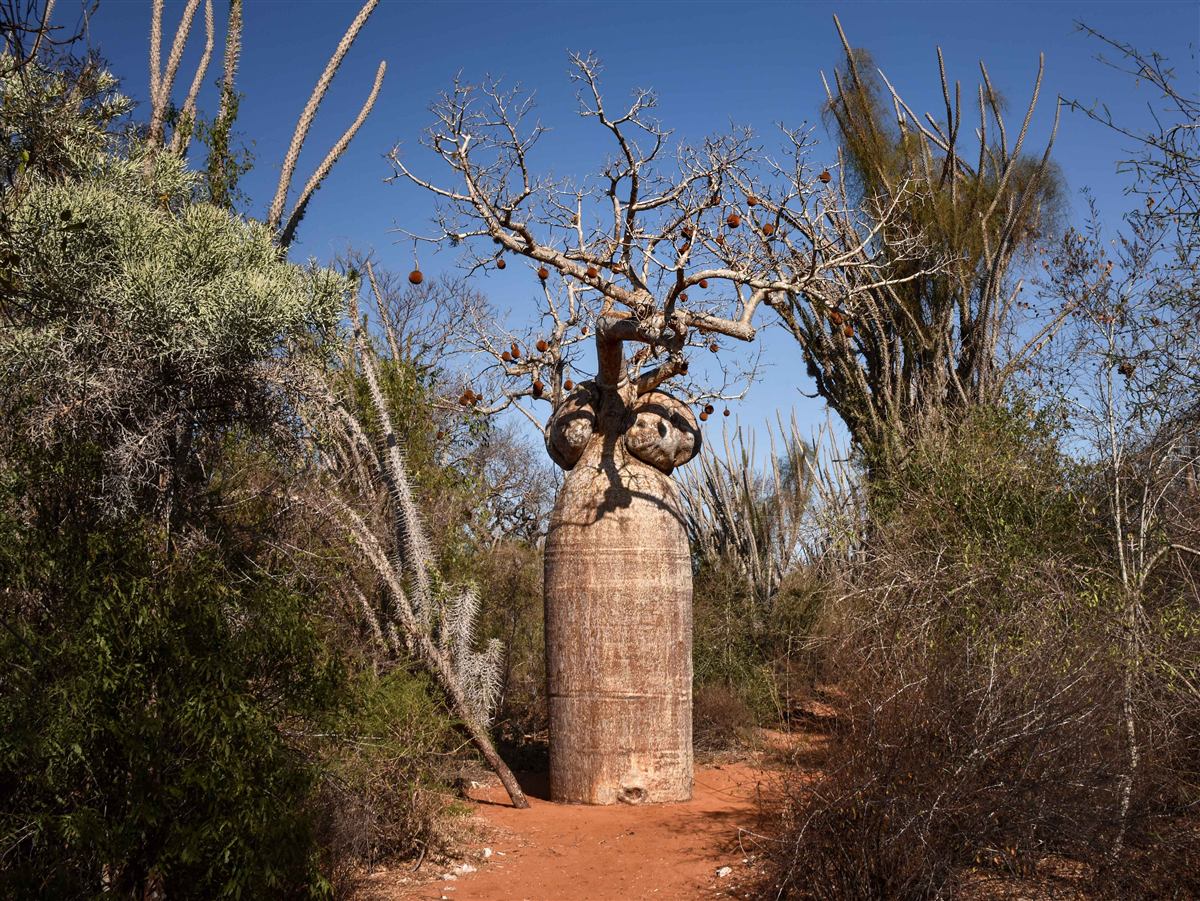
The Didiereaceae: octopus trees that are not cacti
The plants that define the spiny forest are the octopus trees and their relatives, the Malagasy members of the family Didiereaceae. This is one of the few flowering-plant families endemic to Madagascar. Its island genera, Alluaudia, Alluaudiopsis, Decaryia and Didierea, together hold about eleven species, all confined to the south and south-west (Applequist & Wallace, 2000). Didierea madagascariensis is the classic octopus tree, a spiny trunk from which long, curving, thorn-covered arms rise and wave. Alluaudia procera, the tallest of them, grows into a spiny mast up to fifteen metres high and is known, tellingly, as the Madagascar ocotillo.
The naming gives the game away. To the eye these plants are cacti, or ocotillos, or some cross of the two. Their true relationships are quite different. Molecular phylogenies place the Didiereaceae firmly within the order Caryophyllales, in the succulent-rich suborder Portulacineae (Nyffeler & Eggli, 2010). The cacti sit in the same suborder, so the two are distant cousins rather than strangers, but they are separate families that acquired their spiny, water-storing forms along independent paths. The resemblance to the American ocotillo (Fouquieria, family Fouquieriaceae) is more striking still, because the ocotillo belongs to a completely different order, the Ericales. Its likeness to Alluaudia owes nothing to shared ancestry at all.
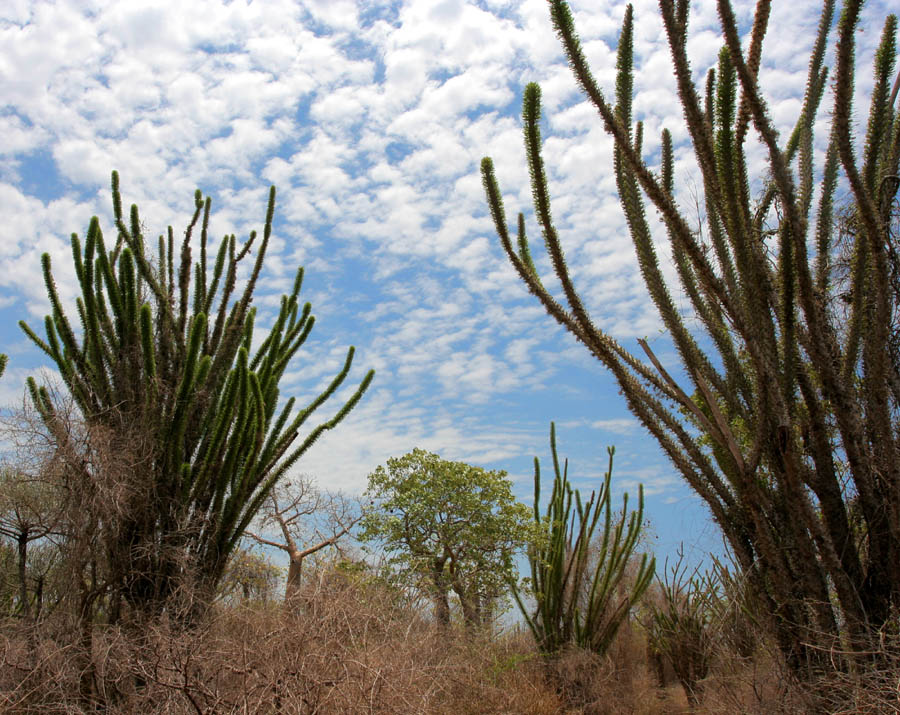
The spiny forest looks like a cactus desert. It contains almost no cacti. What it contains is a separate answer to the same question, worked out in isolation.
How the same shape keeps appearing
Convergence is not magic. A desert imposes a narrow set of demands, and only a few designs meet them, so unrelated lineages keep arriving at the same handful of solutions. Store water in the stem or trunk. Shrink or shed the leaves to cut the surface that loses it. Move photosynthesis into the green stem. Arm the whole plant with spines against the animals that would eat a rare store of moisture. Within the Portulacineae this succulent syndrome has evolved more than once, and comparative genomic work on the group has even found signatures of repeated whole-genome duplication tied to the move into harsh, dry environments (Wang et al., 2019). The spiny forest is where one of those independent experiments has run longest and furthest from any other.
Breathing at night
The most elegant of the drought adaptations is invisible, because it happens in the dark. A plant photosynthesising in the ordinary way must open the pores in its leaves, the stomata, to let carbon dioxide in, and every open pore loses water to the hot air. In a desert that trade is ruinous. Many spiny-desert plants, including succulent Euphorbia and members of the Didiereaceae, get round it with Crassulacean acid metabolism, or CAM. They open their stomata at night, when the air is cool and moist, take in carbon dioxide and lock it into an organic acid, then close the pores tight at daybreak and run photosynthesis through the following day on that stored carbon with almost no further water loss. CAM is one of the most water-thrifty strategies in the plant kingdom, and here it operates under some of the harshest heat any plant faces.
The Pachypodium keep small true leaves and pour their water reserve into a swollen trunk, greening the crown briefly after rain. The Alluaudia flush tiny paired leaves along their spiny stems in the wet season and drop them in drought, leaving the green stem to carry on the work. Same constraint, two different divisions of labour between leaf, stem and trunk.
The Pachypodium deserve a paragraph of their own, because they are the plants most people photograph. Madagascar is the world centre of the genus, with around twenty species, almost all endemic, ranging from squat rock-hugging cushions to the tall bottle-trunked Pachypodium geayi and Pachypodium lamerei of the deep south. They are relatives of the periwinkle, in the Apocynaceae, and share nothing but growth form with the succulents around them, another thread of convergence running through the same flora.
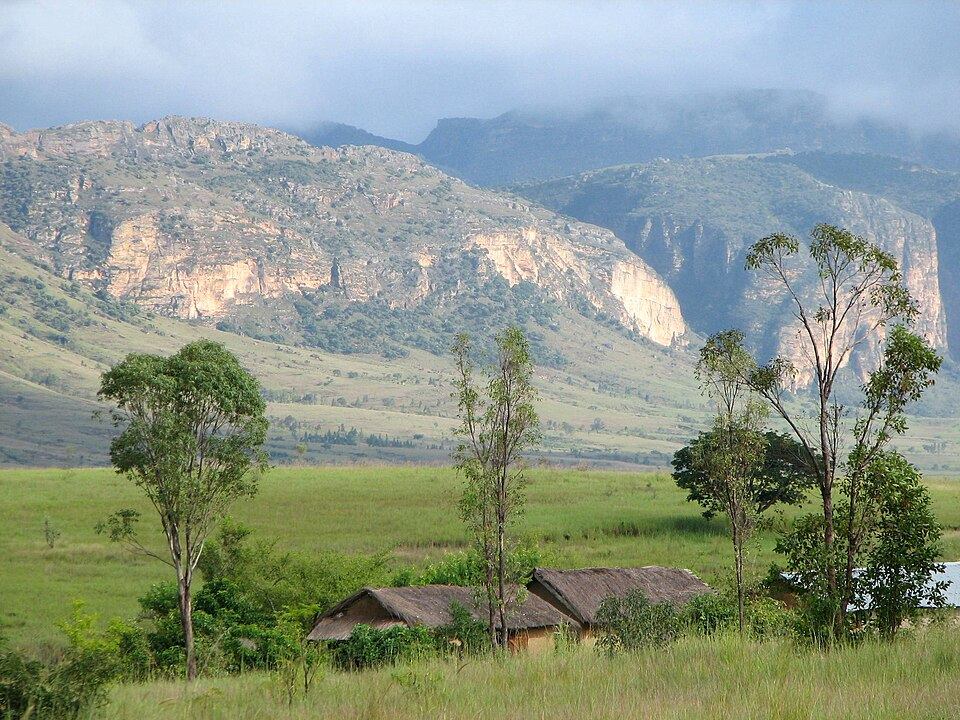
Life among the thorns
The spiny forest is not only plants. Its best-known animal is Verreaux's sifaka (Propithecus verreauxi), a white lemur that leaps between the thorn-armed trunks and, on the ground, moves in a sideways bounding hop that tourists know as the "dancing" lemur. To live among Alluaudia a sifaka must grip spiny stems bare-handed, and the plants and their animals are tied together: the lemurs eat the leaves and flowers, and disperse seeds through the thicket. It is one of many cases in Madagascar where a plant community and the animals that move through it have to be understood as a single system, which is part of why fragmenting the forest does more damage than the loss of tree cover alone suggests.
The fastest-clearing forest on the island
The spiny forest is disappearing faster than any other forest type in Madagascar. It is easier to fell and to burn than the wet eastern forests, and it sits in one of the poorest and most drought-stricken parts of the country, where the forest is an economic safety net of last resort. Two pressures dominate. Slash-and-burn clearance opens land for crops and cattle that the thin soils cannot sustain for long. And charcoal production bakes the slow-growing hardwoods into fuel: across southern Madagascar charcoal is not a barbecue novelty but the fuel that cooks almost every meal (Gardner, 2016). The six decades of national forest data assembled by Vieilledent and colleagues show the dry and spiny south losing cover and breaking into fragments over the whole record (Vieilledent et al., 2018).
On top of clearance sits collection. The showiest succulents, Pachypodium above all, are dug from the wild for the international ornamental trade, and many are now listed under CITES to control it. A slow-growing plant that took decades to reach flowering size, prised out of the ground and shipped abroad, is not quickly replaced. For a species confined to a few square kilometres of the far south, sustained collection is an extinction risk in its own right.
Many spiny-desert plants are known from very little material. Across Madagascar, 1,656 endemic species have a preserved specimen somewhere in the world but none in any national institution, and 537 endemics are known from a single specimen anywhere on Earth. The wider IsoGentiX dataset holds 13,685 recorded plant names for Madagascar. For a succulent found on one stretch of the far south and held only as a sheet in a distant herbarium, the digital record may be the only form in which its own country can study it.
Custody figures are computed from the IsoGentiX Flora dataset, reconciled to the WCVP backbone, and reflect what has so far been digitised and localised.
Decoding is protecting
The spiny forest is a good place to see why recording a plant and protecting it are the same task. An Alluaudia or a Pachypodium that has been named, georeferenced to the patch of thicket it grows in, and assessed for extinction risk can be argued for, licensed against illegal collection, and defended when land use is decided. One known only as an unlabelled specimen in a drawer overseas cannot. Mapping which plant lives where in the far south, and returning that record to Madagascar in a form its own scientists can use, is exactly the work the IsoGentiX Flora Portal exists to do. Decode:Protect.
Common questions
What is Madagascar's spiny desert?
It is the semi-arid spiny forest of Madagascar's far south and south-west, a thorny woodland growing on under about 400 mm of rain a year. Around 95 percent of its plant species and roughly 48 percent of its genera are endemic, the highest plant endemism of any Madagascan biome.
Are the octopus trees a kind of cactus?
No. The octopus trees and their relatives belong to the Didiereaceae, a family found only in Madagascar. Cacti sit in the same order, Caryophyllales, so they are distant cousins rather than close relatives, and the two groups evolved their spiny, water-storing forms independently. The resemblance to the American ocotillo, in a wholly separate order, is pure convergence.
How do spiny-desert plants survive with so little water?
By storing water in swollen stems and trunks, shedding small leaves in the dry season, and in many cases using Crassulacean acid metabolism (CAM), which opens the leaf pores at night to take in carbon dioxide when it is cool and keeps them shut through the heat of the day to cut water loss.
Why is the spiny forest under threat?
It has the highest rate of clearance of any forest type in Madagascar. Slash-and-burn farming and charcoal production remove slow-growing trees that recover poorly, and the showiest succulents such as Pachypodium are dug up for the illegal ornamental trade.
Sources and further reading
- Applequist, W.L. & Wallace, R.S. (2000). Phylogeny of the Madagascan endemic family Didiereaceae. Plant Systematics and Evolution, 221, 157–166. link.springer.com. molecular phylogeny placing the Didiereaceae within the Portulacineae.
- Nyffeler, R. & Eggli, U. (2010). Disintegrating Portulacaceae: a new familial classification of the suborder Portulacineae (Caryophyllales) based on molecular and morphological data. Taxon, 59(1), 227–240. onlinelibrary.wiley.com. family limits within the succulent Portulacineae.
- Wang, N. et al. (2019). Evolution of Portulacineae marked by gene tree conflict and gene family expansion associated with adaptation to harsh environments. Molecular Biology and Evolution, 36(1), 112–126. academic.oup.com. genomic signatures of repeated adaptation to aridity, including the Didiereaceae.
- Antonelli, A. et al. (2022). Madagascar's extraordinary biodiversity: evolution, distribution, and use. Science, 378(6623), eabf0869. science.org
- Callmander, M.W. et al. (2011). The endemic and non-endemic vascular flora of Madagascar updated. Plant Ecology and Evolution, 144(2), 121–125. plecevo.eu
- Moat, J. & Smith, P. (2007). Atlas of the Vegetation of Madagascar. Royal Botanic Gardens, Kew. The standard mapping of the southern spiny thickets and dry forests.
- Vieilledent, G. et al. (2018). Combining global tree cover loss data with historical national forest-cover maps to look at six decades of deforestation and forest fragmentation in Madagascar. Biological Conservation, 222, 189–197. sciencedirect.com
- Gardner, C. (2016). Madagascar's unique 'spiny forest' is fast being turned into charcoal. The Conversation. theconversation.com
- Madagascar spiny thickets ecoregion. World Wildlife Fund / One Earth. oneearth.org. endemism and rainfall figures for the biome.
- Govaerts, R. et al. World Checklist of Vascular Plants (WCVP). Royal Botanic Gardens, Kew. powo.science.kew.org