Madagascar's central highlands
The rolling grasslands of the central plateau were written off for a century as a man-made desert. The plants tell a different story: much of this is an ancient grassy biome, older than people, with its own endemic grasses, everlastings and relict woodland.
- The central plateau is dominated by grassland and wooded grassland, long dismissed as a degraded wasteland but now understood by much recent work as an ancient natural biome.
- Madagascar has around 541 grass species, roughly 40% endemic, an endemism level well above the average for large islands (Vorontsova et al., 2016).
- Endemic highland grass lineages diverged an estimated 1 to 7 million years before humans arrived, and carry deep adaptations to fire and grazing (Solofondranohatra et al., 2020).
- The signature relict woodland is tapia (Uapaca bojeri), a fire-tolerant, thick-barked endemic tree that hosts the wild silkworm Borocera cajani.
- The debate is genuine and not fully closed: isotope evidence from subfossil animals argues for a shifting mosaic of forest and grassland rather than one uniform grassy plain (Crowley et al., 2021).
- Island-wide, Madagascar holds roughly 11,516 native vascular plants, about 82% endemic (Antonelli et al., 2022; Callmander et al., 2011).
Fly over Madagascar's central plateau and you see it for hundreds of kilometres: open, rolling grassland, reddening in the dry season, broken by rice valleys and scattered patches of woodland. For most of the twentieth century this was read as a wound. The standard account said the highlands had once been clothed in forest, that people had cut and burned it away, and that the grass was what grew back on ruined ground. The grasslands were a "green desert", a wasteland, the sign of an island wrecked by its own inhabitants. That story shaped policy for decades, and it is largely wrong.
The plants themselves have overturned it. Over the last two decades, work on the evolution, endemism and functional biology of the highland grasses has shown that this is not young ground left by clearance. It is one of the oldest surfaces of vegetation on the island, an ancient grassy biome with a flora tuned to fire and grazing long before any person set foot on Madagascar. The plateau is not the scar of a lost forest. It is an ecosystem in its own right, and one that conservation had been quietly trying to destroy.
Grass richness and endemism follow Vorontsova et al. (2016); divergence estimates for endemic highland grass lineages follow Solofondranohatra et al. (2020). Human arrival dates are debated but fall within roughly the last one to two thousand years, orders of magnitude younger than the grass flora.
Where the wasteland idea came from
The degraded-forest reading was reasonable on its face. Madagascar has lost a great deal of real forest, and the eastern rainforest and western dry forest have genuinely been cut and burned back over centuries (Vieilledent et al., 2018). Fire is everywhere on the plateau in the dry season, most of it lit by people to green up pasture for zebu cattle. Colonial foresters saw fire, saw grass, saw few trees, and concluded that the grass was the aftermath of forest destruction. The Malagasy word tanety, the bare grassy hills, came to stand for degradation itself.
The problem is that the reasoning ran backwards. Fire on a grassland is not proof that the grassland used to be forest, any more than rain on the sea proves the sea used to be land. To test where the grass came from, you have to ask the grass. When botanists finally did that, systematically, the answer did not fit the wasteland story at all.
What the grasses reveal
The first line of evidence is endemism. If the highland grasslands were a recent, human-made habitat colonised by weedy species from elsewhere, you would expect the grass flora to be young, widespread and unremarkable. It is the opposite. Of roughly 541 grass species recorded on the island, about 40 percent are found nowhere else (Vorontsova et al., 2016). That level of endemism is well above what you see on other large islands, and it is not what a freshly disturbed, weed-filled landscape looks like. High endemism takes time. It is the signature of a flora that has been evolving in place for a very long while.
The second line is the shape of the communities. Vorontsova and colleagues found strong regional turnover in grass species from one part of the island to another, and a pattern of phylogenetic assembly in which the least-disturbed grasslands hold an even spread of distantly related lineages, while only the most heavily grazed and trampled sites are packed with close relatives. That is the reverse of what a purely anthropogenic grassland should show. The grass communities behave like old assemblages that human disturbance has recently reshaped at the edges, not like something people built from scratch.
Fire on a grassland is not proof that the grassland used to be forest. To find out where the grass came from, you have to ask the grass.
The third line is physiology, and it is the sharpest. Most highland grasses are C4 plants, using a form of photosynthesis that concentrates carbon dioxide inside the leaf and pays for itself only in open, sunlit, warm conditions. C4 grasses are the engine of the world's savannas precisely because they thrive in high light and tolerate fire and drought. A shady forest floor is the wrong place for them. Solofondranohatra and colleagues sampled 56 sites across the central highlands and 71 grass species, and found a clean switch: shady woodland and forest hold C3 grasses with soft, herbaceous, creeping leaves, while the open grassland and its wooded margins are dominated by tall, tough-leaved perennial C4 grasses (Solofondranohatra et al., 2018). The grassland flora is functionally built for open, fire-prone ground. It is not stranded forest-floor vegetation waiting for a canopy to return.
This grass and fire feedback is not unique to Madagascar. Across the tropics, huge areas that the climate could in principle support as forest are held open as grassland and savanna by fire, a point made globally by Bond and colleagues, whose modelling showed that closed forest would roughly double its extent if fire were removed, mostly at the expense of C4 grasslands (Bond et al., 2005). Grassy biomes are alternative stable states, kept open by disturbance, not failed forests. Madagascar's plateau is one instance of a worldwide pattern.
The deepest evidence: fire and grazing older than people
The strongest test came from asking not just how old the grasses are, but how old their adaptations are. Solofondranohatra and colleagues split the highland grass flora into two functional assemblages. One is a fire assemblage: tall, tufted, caespitose grasses with narrow leaves and low bulk density, the kind of growth that cures to fine flammable fuel and carries fire well. The other is a grazing assemblage: low, mat-forming, high-density grasses with wider leaves, the kind that survives being cropped and trampled. These are the same two syndromes seen in Africa's ancient savannas, shaped by millions of years of fire and large herbivores (Solofondranohatra et al., 2020).
Crucially, the endemic grasses carrying these traits diverged an estimated one to seven million years before humans arrived. The fire-adapted and grazing-adapted floras were already assembled and evolving in place long before anyone was there to light a match or herd a cow. The grazing story has a twist that closes the argument. Before people came, Madagascar had its own large grazers and browsers: giant tortoises, hippopotamuses, and other now-extinct megafauna. The grazing-adapted grasses evolved with them. When those animals were lost, zebu cattle arrived and stepped into much the same role, which is why the introduced cattle did not so much create the grassland as inherit it.
Tapia: the relict woodland
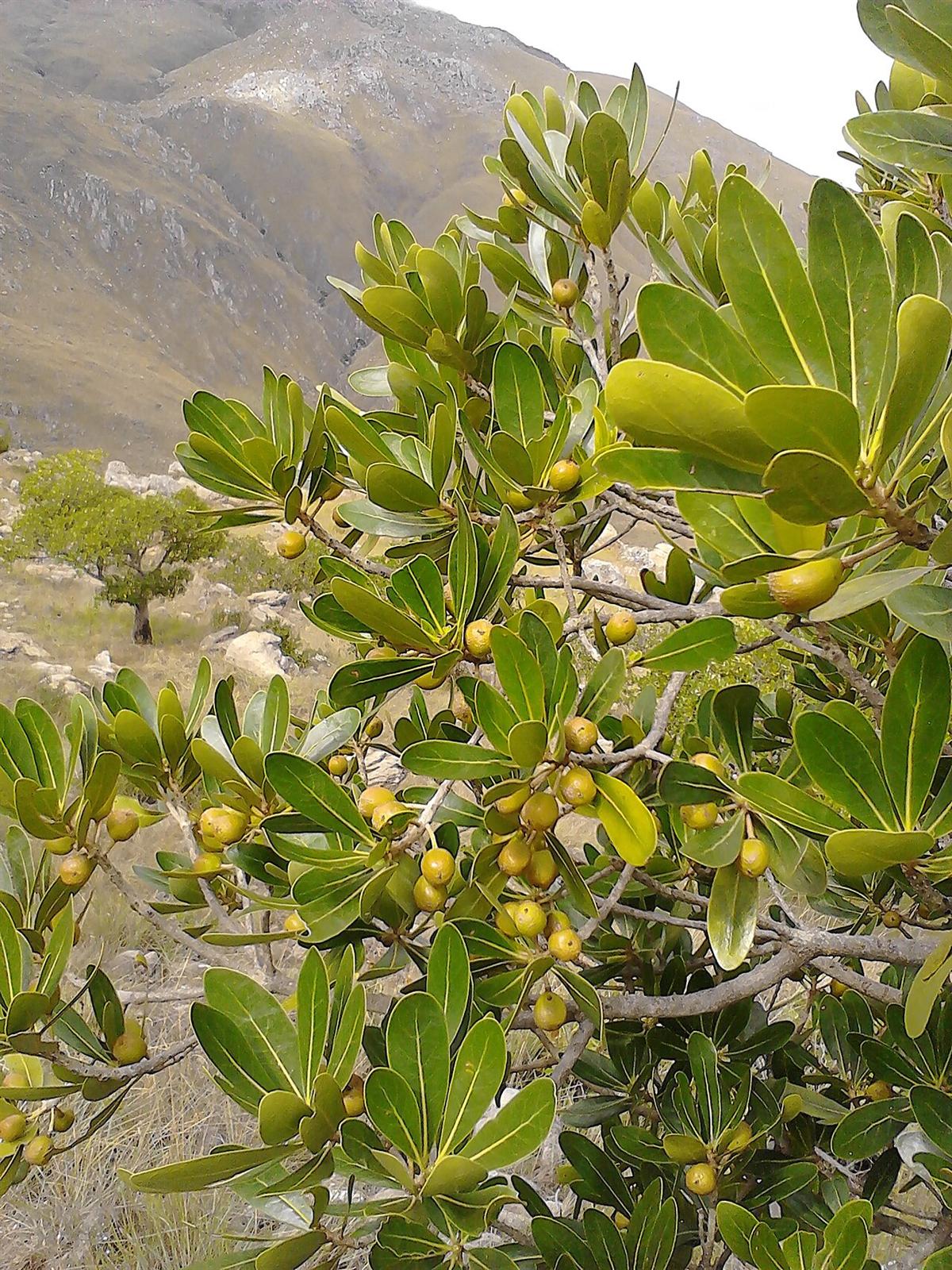
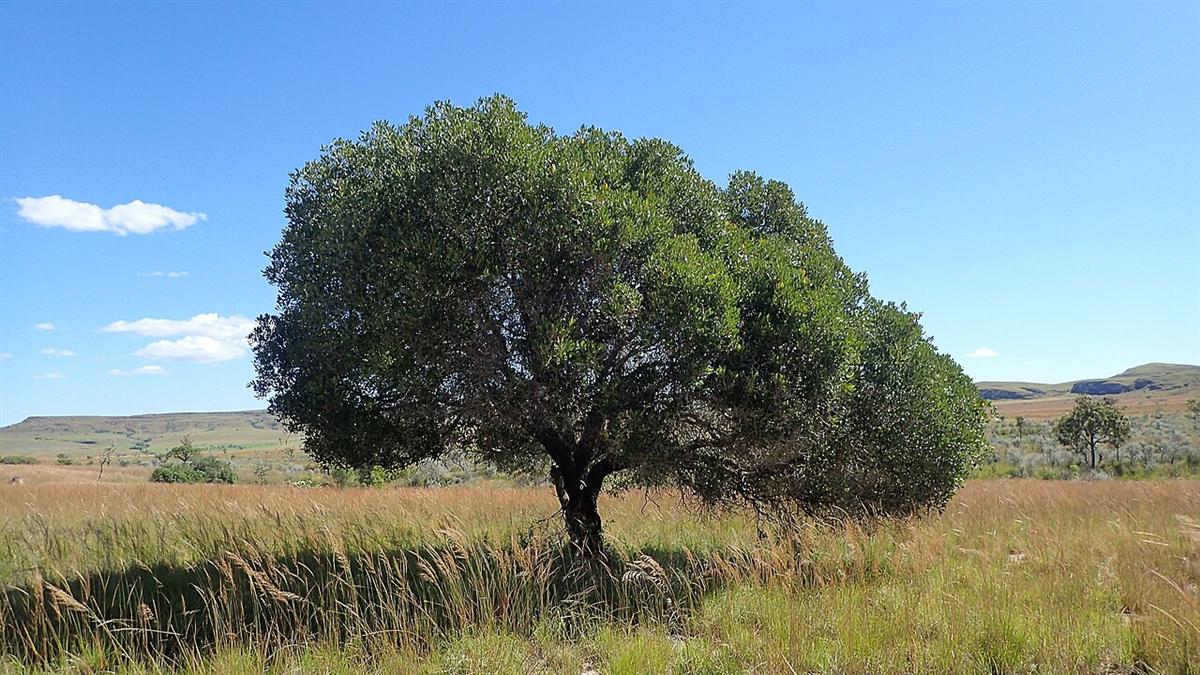
The plateau is not all grass. Scattered across it are stands of tapia woodland, often dominated by a single tree, Uapaca bojeri, an endemic sclerophyll with small, hard, drought-resistant leaves and thick, corky, fire-resistant bark. Tapia is the woodland that belongs with the grassland, not against it. Its bark lets it survive the grass fires that kill thinner-barked forest trees, and Solofondranohatra's team found that woodland Uapaca carry bark at least twice as thick as their forest relatives, exactly what you expect of a tree adapted to a fire-prone open habitat rather than a closed one (Solofondranohatra et al., 2018).
Tapia woodland is also a working landscape. It hosts Borocera cajani, the endemic wild silkworm whose cocoons are gathered for Malagasy wild silk, and its fruits, mushrooms and firewood have supported highland communities for generations. The old label for tapia was, again, "degraded". Kull's study of highland fire and land use showed how that label misread a fire-shaped, long-inhabited woodland as simply damaged forest, and how local burning is part of what keeps the tapia system going rather than the thing destroying it (Kull, 2002). The pattern repeats: read fire as damage, and you misread the whole biome.
The high peaks: heath and everlastings
Above the grassland, on the highest massifs of the plateau, the flora changes again. On exposed rocky summits and ridges the vegetation shifts towards montane heath, thick with Ericaceae, the heather family, whose small tough leaves handle cold, wind and thin soil. With them grow a great diversity of Asteraceae, the daisy family, including the everlastings, Helichrysum and its relatives, whose papery, straw-textured flower heads hold their shape and colour long after they dry. Madagascar is a centre of diversity for Helichrysum, and these high, open communities are as endemic-rich as anything lower down. They are also, like the grassland, adapted to open conditions and frequent disturbance, not to forest shade.
The custody problem that runs through Madagascar's flora is acute for the plateau. Across the island, 1,656 endemic species have a preserved specimen somewhere in the world but none in any Madagascar institution, and 537 endemics are known from a single specimen anywhere on Earth. For an endemic highland grass or everlasting whose only vouchers sit in overseas herbaria, the digital record may be the only form in which its own country can study it.
Custody figures are computed from the IsoGentiX Flora dataset (reconciled to the WCVP backbone) and reflect what has so far been digitised and localised. The site-wide dataset holds 13,685 recorded plant names for Madagascar.
Is the argument settled?
Not entirely, and it would be false to say so. The ancient-biome case is strong for the grass flora, but the picture of the whole highland over the last tens of thousands of years is still being worked out. Crowley and colleagues, reading the carbon isotopes locked in the bones and teeth of subfossil animals, argue that the plateau was not one uniform sea of grass but a shifting mosaic, with forest, woodland and grassland waxing and waning at different elevations and in different periods, driven by climate as well as fire and grazing (Crowley et al., 2021). That does not revive the wasteland idea. C4 grasses were present and ancient in their account too. It refines it: the natural plateau was patchy and dynamic, and the balance of grass and tree moved over time.
The honest summary is this. The grasslands are old and natural, the grass flora is ancient and endemic-rich, and treating the whole plateau as ruined forest is a mistake. How much of the highland was grass versus forest at any given moment, and exactly where the boundaries sat, is still an active question. Both statements are true at once, and good science holds them together rather than collapsing back to a single tidy story.
Decoding is protecting
The plateau shows why documenting a flora accurately is not a neutral, after-the-fact activity. For decades a misreading of the highland grasslands drove policy towards tree planting and fire suppression, responses that, taken across the natural grassland, would have destroyed an ancient endemic-rich biome in the name of restoring it. The correction came from botany: from counting the grasses, mapping where they grow, reading their physiology, and dating their lineages. A plant recorded, named, georeferenced and understood can be defended for what it is. One misfiled as the wreckage of something else cannot. Returning that record to Madagascar, in a form its own scientists can use, is exactly the work the IsoGentiX Flora Portal exists to do. Decode:Protect.
Common questions
Are Madagascar's highland grasslands natural or man-made?
The long-standing view was that they were a degraded wasteland left by forest clearance and fire. Recent evidence, from the antiquity of the grass flora, its high endemism and its deep adaptations to fire and grazing, points the other way: much of the grassy highland is an ancient natural biome that predates human arrival. People expanded and altered it rather than creating it.
How old are the highland grasslands?
Older than people on the island. Humans arrived within roughly the last one to two thousand years, but endemic grass lineages of the central highlands diverged an estimated one to seven million years before that, and the grass communities are most likely Neogene in age.
What is tapia woodland?
Tapia woodland is a fire-tolerant, often single-species woodland of the central highlands dominated by Uapaca bojeri, an endemic sclerophyllous tree with thick fire-resistant bark. It is a relict of the natural wooded grassland and hosts the endemic wild silkworm Borocera cajani.
Why does it matter whether the grasslands are ancient?
It changes what conservation should do. If the grasslands are degraded forest, the goal is to plant trees. If they are an old natural biome, blanket tree planting destroys an endemic-rich ecosystem, and the right response is to protect the grassland and its fire and grazing regime instead.
Sources and further reading
- Vorontsova, M.S., Besnard, G., Forest, F. et al. (2016). Madagascar's grasses and grasslands: anthropogenic or natural? Proceedings of the Royal Society B, 283(1823), 20152262. royalsocietypublishing.org. Grass endemism (~40% of ~541 species) and the case that the communities are Neogene, not Holocene and human-made.
- Solofondranohatra, C.L., Vorontsova, M.S., Hackel, J. et al. (2018). Grass functional traits differentiate forest and savanna in the Madagascar central highlands. Frontiers in Ecology and Evolution, 6, 184. frontiersin.org. 56 sites, 71 species; C3-forest versus C4-savanna switch and the thick fire bark of woodland Uapaca.
- Solofondranohatra, C.L., Vorontsova, M.S., Hempson, G.P. et al. (2020). Fire and grazing determined grasslands of central Madagascar represent ancient assemblages. Proceedings of the Royal Society B, 287(1927), 20200598. royalsocietypublishing.org. Fire and grazing functional assemblages, and their divergence millions of years before people.
- Crowley, B.E., Godfrey, L.R., Hansford, J.P. & Samonds, K.E. (2021). Seeing the forest for the trees, and the grasses: revisiting the evidence for grazer-maintained grasslands in Madagascar's central highlands. Proceedings of the Royal Society B, 288(1950), 20201785. royalsocietypublishing.org. The counter-case for a shifting forest and grassland mosaic rather than uniform grassland.
- Bond, W.J., Woodward, F.I. & Midgley, G.F. (2005). The global distribution of ecosystems in a world without fire. New Phytologist, 165(2), 525–538. nph.onlinelibrary.wiley.com. Grassy biomes as fire-maintained alternative stable states, not failed forest.
- Kull, C.A. (2002). The "degraded" tapia woodlands of highland Madagascar: rural economy, fire ecology, and forest conservation. Journal of Cultural Geography, 19(2), 95–128. doi.org. Tapia (Uapaca bojeri) woodland, fire and the misreading of a fire-shaped landscape as degraded forest.
- Antonelli, A. et al. (2022). Madagascar's extraordinary biodiversity: evolution, distribution, and use. Science, 378(6623), eabf0869. science.org. Island-wide native and endemic plant totals.
- Callmander, M.W. et al. (2011). The endemic and non-endemic vascular flora of Madagascar updated. Plant Ecology and Evolution, 144(2), 121–125. plecevo.eu
- Vieilledent, G. et al. (2018). Combining global tree cover loss data with historical national forest-cover maps to look at six decades of deforestation and forest fragmentation in Madagascar. Biological Conservation, 222, 189–197. sciencedirect.com
- Moat, J. & Smith, P. (2007). Atlas of the Vegetation of Madagascar. Royal Botanic Gardens, Kew. The standard mapping of Madagascar's vegetation types, including the highland grasslands and tapia.