Madagascar's dry deciduous forests
The seasonally dry forests of the west drop their leaves to survive months without rain. They hold the island's giant baobabs and its most valuable timbers, and they are among the most threatened, and most heavily plundered, forests on Earth.
- The western dry deciduous forests are drought-deciduous: most trees shed their leaves through the long dry season, roughly April to November, to survive months with almost no rain.
- They hold Madagascar's seven endemic baobabs (Adansonia), the seventh, A. bozy, recognised in 2026; a 2024 study argues the whole genus originated here (Wan et al., 2024; Karimi et al., 2026).
- They are the home of the island's rosewoods and palisanders (Dalbergia): around fifty species, nearly all endemic, and among the world's most valuable timbers.
- The whole genus Dalbergia was listed on CITES Appendix II in 2013, yet illegal logging and trafficking have continued (TRAFFIC; Waeber et al., 2019).
- The dry west is among the most threatened biomes in Madagascar, easier to clear and burn than the wet east and losing cover for six decades (Vieilledent et al., 2018).
For half the year the forests of western Madagascar look dead. From about April to November almost no rain falls, and the trees respond by dropping their leaves, standing grey and bare over pale grass and cracked earth. Then the rains arrive, and within days the same forest is green, flowering and loud with life. This is the dry deciduous forest, a flora built entirely around the rhythm of the dry season, and it is unlike anything in the dripping rainforests of the eastern escarpment.
It is also the most iconic of Madagascar's biomes and the most exploited. The giant baobabs that stand in every photograph of the island grow here. So do the rosewoods and palisanders that have made western Madagascar a target for one of the largest illegal timber trades on Earth. The dry forest is where the island's beauty and its plunder meet, which is exactly why what survives of it needs reading and defending now.
Baobab count: Wan et al. (2024). Dalbergia species figures follow the taxonomic literature on Malagasy rosewoods (Hassold et al., 2016). Forest-loss figure: Vieilledent et al. (2018), for Madagascar as a whole. Where a figure is site-specific or contested, the text says so.
Living by the dry season
The western forests sit in Madagascar's rain shadow. The trade winds drop most of their moisture on the eastern slopes, so the west is markedly drier, with a wet season concentrated into a few summer months and a dry season that can run for six or seven months with next to no rain. A forest that must survive that has two options: hold water, or shut down. The dry deciduous forest does both.
Dropping leaves is the shutdown strategy. A leaf is where a plant loses water, breathing it out through its pores while it takes in carbon dioxide. In a long drought that trade stops being worth it, so the tree cuts its losses, literally, by shedding its whole canopy. With no leaves to lose water through, it can wait out the dry months on stored reserves, then flush a new canopy in a matter of days when the rains break. It is the same logic that strips a European oak in autumn, applied to drought rather than cold. The holding strategy is succulence, and the western forest's masters of it are the baobabs, which pour the wet season's water into swollen, fibrous trunks and draw it down through the dry.
The baobabs
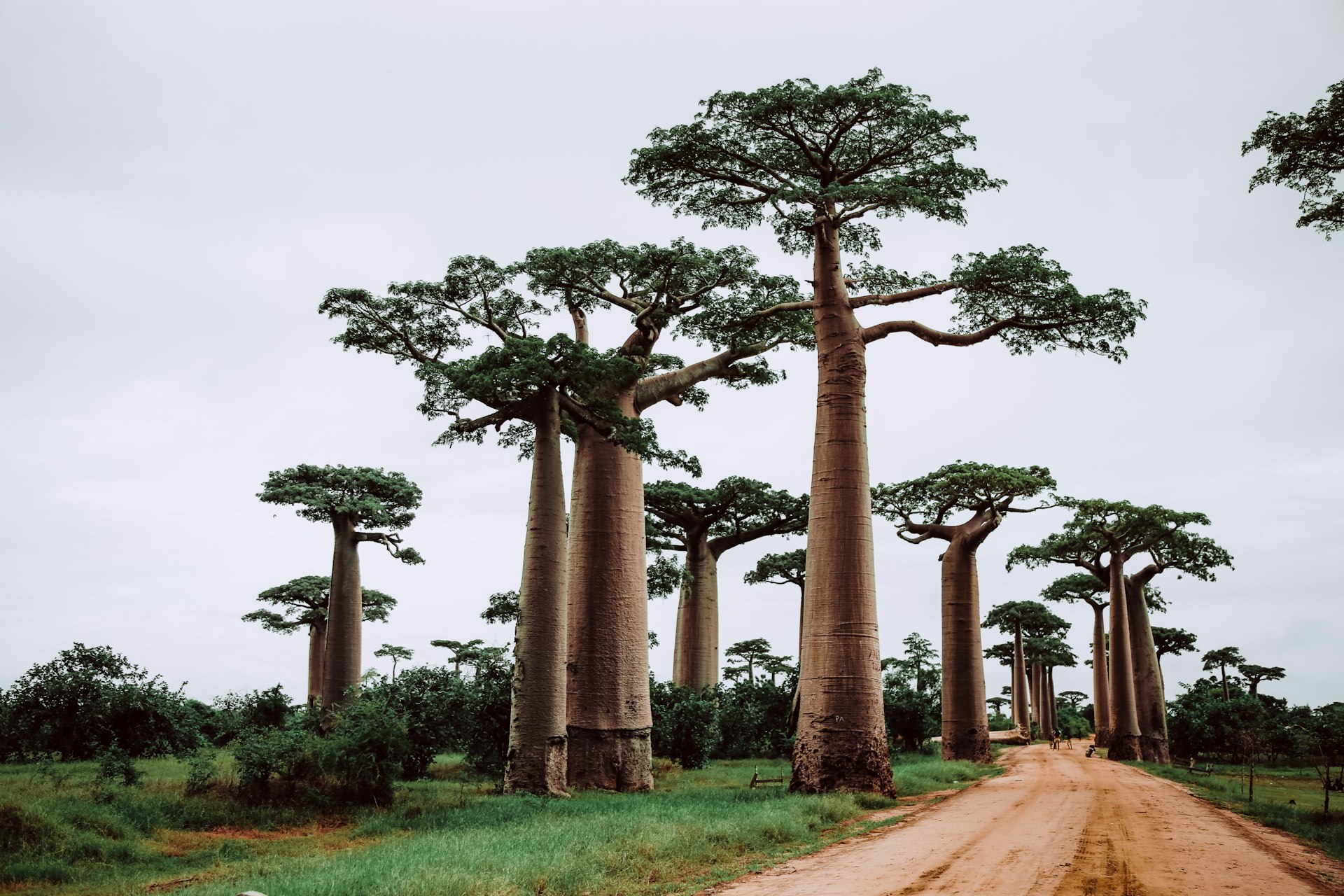
No plant says Madagascar like the baobab. Of the world's nine baobabs, seven species are endemic to the island, against two on mainland Africa and Arabia and one in Australia. The seventh, Adansonia bozy, was recognised only in 2026 after genome-scale analysis separated it from A. za (Karimi et al., 2026). A 2024 study that sequenced the genomes of all living baobabs went further, arguing that the genus Adansonia originated on Madagascar and radiated out from it across the Indian Ocean, which would make the island not just the stronghold of these trees but their birthplace (Wan et al., 2024). They are members of the mallow family, the Malvaceae, and they can live for many centuries and grow trunks several metres across.
The seven Malagasy species divide the dry country between them. Grandidier's baobab (Adansonia grandidieri), the tallest and most photographed, is the tree of the Menabe region around Morondava. Others, such as Adansonia rubrostipa and Adansonia za, spread through the dry and spiny forests further south. Several are assessed as threatened, and their difficulty is not only cutting but regeneration: baobabs are slow to establish, and where the surrounding forest has been cleared for farmland the old giants are often left standing with no young trees coming up behind them.
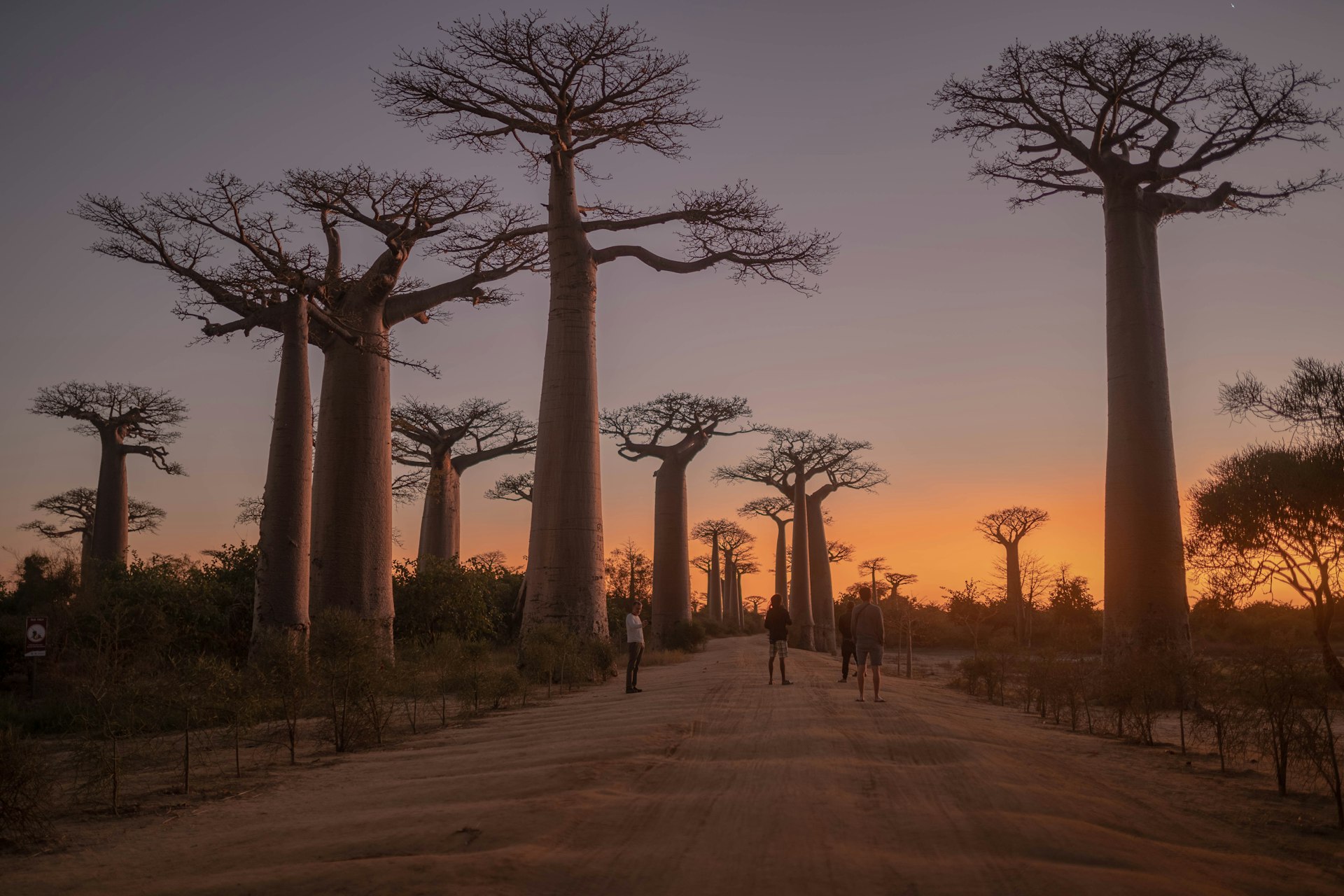
A baobab avenue is a beautiful thing and a warning at once: the giants remain, but the forest that made them is gone.
The rest of the dry-forest cast
The baobabs are the giants, but the dry forest is a whole community. Its canopy and understorey are dominated by drought-deciduous trees from a handful of families. The Commiphora, in the frankincense and myrrh family (Burseraceae), are among the most numerous, many of them endemic, several with peeling bark and aromatic resin. Hildegardia and other mallows, Cedrelopsis, Poupartia and members of the Combretaceae fill out the canopy, while spiny and succulent plants creep in from the south where the dry forest grades into the spiny desert. Where the dry forest meets limestone it wraps around the tsingy massifs, whose sharp rock has sheltered pockets of it from fire and the axe.
And then there are the rosewoods. The genus Dalbergia, in the pea family (Fabaceae), is represented on Madagascar by around fifty species, nearly all of them endemic (Hassold et al., 2016). Their dense, dark, fragrant timber is sold as bois de rose (rosewood) and palissandre (palisander), and it is some of the most valuable wood in the world. That value has made the dry and eastern forests where these trees grow the target of an illegal trade on a scale that has reshaped the country's politics.
The rosewood crisis
Madagascar's rosewood trade is one of the clearest cases anywhere of a plant being worth more dead than the law can protect. A single large log can be worth thousands of dollars once it reaches the furniture workshops of East Asia, and demand has stripped valuable Dalbergia from forests and even from protected areas. Logging surged during the country's political crises, when enforcement collapsed, and the trade has been estimated to move hundreds of thousands of trees. In 2014 a single seizure in Singapore, of nearly thirty thousand logs traced to Madagascar, became one of the largest ever of a CITES-listed species.
| Point | What happened |
|---|---|
| 2009 onward | Political crisis weakens enforcement; large-scale illegal logging of rosewood and ebony spreads, including inside protected areas. |
| 2013 (CITES CoP16) | All Malagasy Dalbergia species listed on CITES Appendix II, requiring permits for international trade. |
| 2014 | Nearly 30,000 Madagascar rosewood logs seized in Singapore, among the largest seizures of a CITES species on record. |
| 2019 onward | Researchers call for uplisting to Appendix I; unsecured stockpiles and falsified permits keep trafficking alive (Waeber et al., 2019). |
Sequence compiled from the TRAFFIC CITES briefing on Madagascar's rosewood and ebonies and from Waeber et al. (2019). Figures for seizures and volumes are those reported in those sources.
The legal response has been real but only partly effective. Listing the whole genus on CITES Appendix II in 2013 made international trade in Malagasy rosewood require permits, and Madagascar has passed national decrees against cutting, transport and export. Yet the trade has continued. Permits are falsified to claim the wood came from continental Africa, or to describe it under vague names that dodge checkpoints, and huge stockpiles of already-cut logs sit unsecured, providing cover for laundering fresh timber as old stock. Conservation researchers have argued that the only way out is to uplist Dalbergia and the ebonies (Diospyros) to Appendix I and stop the stockpile speculation for good (Waeber et al., 2019). The barcoding of Malagasy rosewoods, matching a seized log back to its species by its DNA, is now part of the enforcement toolkit precisely because paperwork cannot be trusted (Hassold et al., 2016).
Among the most threatened biomes on the island
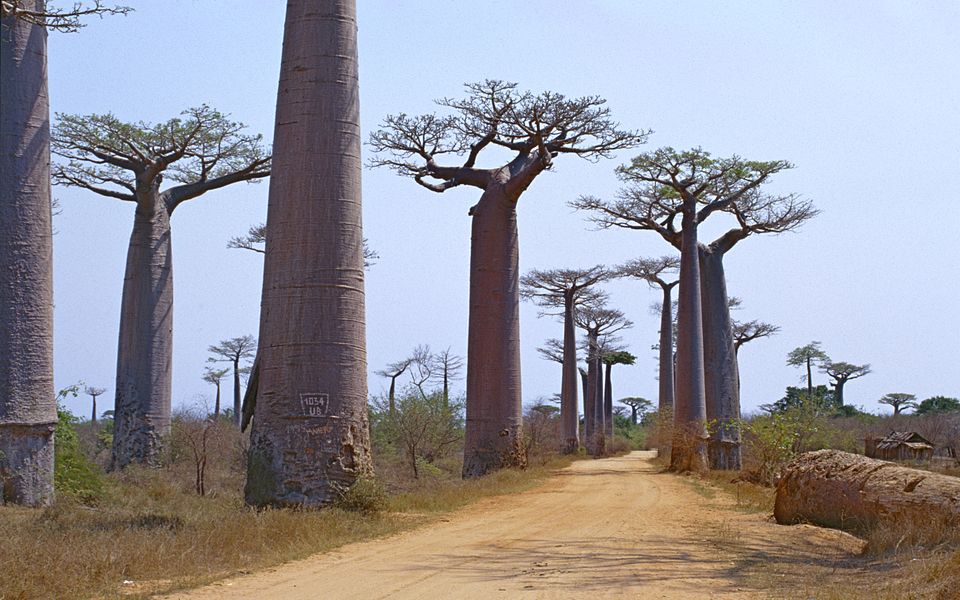
The dry deciduous forests are being lost faster than almost any other habitat in Madagascar. They are easier to clear and to burn than the wet eastern forests, and much of the west has been converted to pasture and to rice, or burned repeatedly to green up grazing. The six decades of national forest data assembled by Vieilledent and colleagues show the dry west losing cover and fragmenting steadily, part of a national loss of around 44 percent of natural forest between 1953 and 2014, with much of what remains now close to a forest edge (Vieilledent et al., 2018). A fragmented dry forest keeps losing species long after the clearing stops, and it burns more easily each year.
That combination, a flora of high value and a habitat under heavy pressure, makes the documentation problem urgent. Many dry-forest plants are known from very little material, and some of the trees being cut have never been properly studied alive.
Across Madagascar, 1,656 endemic species have a preserved specimen somewhere in the world but none in any national institution, and 537 endemics are known from a single specimen anywhere on Earth. For a rosewood or a dry-forest tree being felled faster than botanists can work, the digital record may end up being the only form in which its own country can study it, and the only baseline against which a seized log can be identified.
Custody figures are computed from the IsoGentiX Flora dataset (reconciled to the WCVP backbone) and reflect what has so far been digitised and localised.
Decoding is protecting
The dry forest shows why documentation and protection are one task. A Dalbergia species that is recorded, named, georeferenced and backed by a DNA reference can be assessed for extinction risk, argued for in a management plan, and used to identify a trafficked log at a port. One known only as an unlabelled sheet in a distant drawer cannot do any of that. Mapping which tree grows where across the west, holding a reference against which seized timber can be matched, and returning that record to Madagascar in a form its own scientists and enforcers can use, is exactly the work the IsoGentiX Flora Portal exists to do. Decode:Protect.
Common questions
What is Madagascar's dry deciduous forest?
It is the seasonally dry forest of western Madagascar, where most trees drop their leaves through the long dry season, roughly April to November, to survive months with almost no rain. It is defined by baobabs, rosewoods, Commiphora and a flora built around the management of water.
Why do the trees drop their leaves?
To conserve water. Leaves lose water through their pores, so shedding them in the dry season cuts water loss to almost nothing. The tree waits out the drought on stored reserves and leafs out again when the rains return. Baobabs go further, storing water in swollen trunks.
How many baobab species does Madagascar have?
Seven, all endemic to the island, since Adansonia bozy was recognised in 2026. Two more grow in mainland Africa and Arabia and one in Australia. A 2024 genomic study argued that the whole genus Adansonia originated on Madagascar and spread out from it across the Indian Ocean (Wan et al., 2024).
Why is Madagascar rosewood so threatened?
Its timber, sold as bois de rose and palissandre, is among the most valuable in the world. Illegal logging surged during the country's political crises, and despite the whole genus being listed on CITES Appendix II in 2013 and national bans, trafficking has continued through falsified permits and laundered stockpiles.
Sources and further reading
- Wan, J.-N. et al. (2024). The rise of baobab trees in Madagascar. Nature, 629, 1091–1099. nature.com. six endemic Malagasy baobabs; Madagascar as the centre of origin of the genus.
- Karimi, N. et al. (2026). Phylogenomic analysis of Madagascar's baobabs reveals admixed populations and supports resurrection of a previously described species. TAXON. Open access. onlinelibrary.wiley.com, the 2026 recognition of Adansonia bozy as a seventh Malagasy baobab.
- Waeber, P.O. et al. (2019). Uplisting of Malagasy precious woods critical for their survival. Biological Conservation, 235, 89–95. sciencedirect.com. the case for moving Dalbergia and Diospyros to CITES Appendix I, and the stockpile problem.
- TRAFFIC. CITES CoP19: Madagascar's rosewood and ebonies. The Wildlife Trade Monitoring Network. traffic.org. the 2013 Appendix II listing, illegal logging volumes and enforcement gaps.
- Hassold, S. et al. (2016). DNA barcoding of Malagasy rosewoods: towards a molecular identification of CITES-listed Dalbergia species. PLOS ONE, 11(6), e0157881. journals.plos.org. the diversity of Malagasy Dalbergia and the DNA reference approach to identifying seized timber.
- Vieilledent, G. et al. (2018). Combining global tree cover loss data with historical national forest-cover maps to look at six decades of deforestation and forest fragmentation in Madagascar. Biological Conservation, 222, 189–197. sciencedirect.com
- Moat, J. & Smith, P. (2007). Atlas of the Vegetation of Madagascar. Royal Botanic Gardens, Kew. the standard mapping of Madagascar's vegetation types, including the western dry forests.
- Antonelli, A. et al. (2022). Madagascar's extraordinary biodiversity: evolution, distribution, and use. Science, 378(6623), eabf0869. science.org
- Callmander, M.W. et al. (2011). The endemic and non-endemic vascular flora of Madagascar updated. Plant Ecology and Evolution, 144(2), 121–125. plecevo.eu
- Govaerts, R. et al. World Checklist of Vascular Plants (WCVP). Royal Botanic Gardens, Kew. powo.science.kew.org. the taxonomic backbone the IsoGentiX figures reconcile to.
- Catalogue of the Vascular Plants of Madagascar. Missouri Botanical Garden, MNHN Paris, Parc de Tsimbazaza and partners. efloras.org